 Handpicked
Best Air Compressors & Inflators (Sep 2026)
16 products · 1 buying guide
Handpicked Reviews
Rated by Marcus Reed, Roadside Gear Editor · Published in Sep 2026.

Air Compressors & Inflators compared on tank size and CFM against the tools you run, plus how long the duty cycle allows continuous use. How we rate
See also: Portable
Shop by price: Under $50 · Under $100
At a Glance: Our Top Picks


Top picks in Air Compressors & Inflators
Ranked by our editors — the same order as Best Portable Air Compressors and Tire Inflators for 2026. HPR is the score we gave in that guide; we do not publish a second, unexplained score.
Features (3)
- Cordless inflator, so no clamping to a donor battery under the hood
- Ranked Best Overall here, HPR 9.5, $129.99, 4.6, 2,914 ratings
- Step 1 before winter: charge it, since cordless has no alternator backup
Features (3)
- Cordless 12VDC pack, so no cigarette-lighter cord stretching to reach
- Rank #2 Best Value at HPR 9.3, 4.5 stars, 3,482 reviews, $62.99
- No cord to the socket means stored charge decides winter-morning service
Features (3)
- Double cylinder, 150 PSI, 45 LPM, 20 in hose, $89.99
- 45 LPM from two cylinders; rank #3 for trucks, HPR 9.1
- 5 in LED; no peak-amp spec, so verify rear-valve hose reach

Features (3)
- 150 PSI cordless pump, battery and pressure gauge built in
- Rank #4 cordless under $40, HPR 9.0, $39.99 at writing
- Recharge before winter; 150 PSI ceiling, skip big truck tires

Features (3)
- 1080W dual-cylinder, 10.6 CFM, 150 PSI, 12V offroad pump
- Ranked #5 Best for High Volume, HPR 8.9, 140 reviews
- Cold-morning job: $113.69 pump still needs live 12V to run

Features (3)
- 150 psi rechargeable cordless pump, built-in gauge, $49.99 at writing
- Rank #6 among Best Compact, HPR 8.8, but 126 reviews is thin
- Cold morning, no cord to your battery: charge it monthly

Features (3)
- 12 V feed, 7.06 CFM, 150 PSI ceiling, ¼ NPT quick connector
- AirCtrl target pressure at $129.99, no needle-watching mid-fill
- Suits 4x4 and RV tires, though 120 reviews is a thin trail
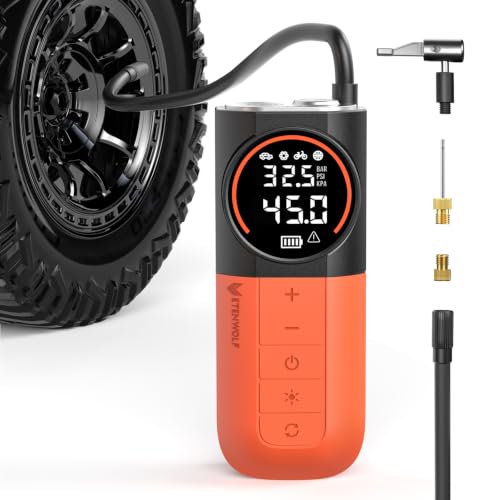
Features (3)
- 160 PSI cordless inflator; battery lives inside, no socket tether
- HPR 8.6, rank #8 Best Budget, 4.5 stars, 314 reviews, $37.99
- Step 1 in winter: charge monthly indoors, cold cells hold less
Air Compressors & Inflators Picks


Air Compressors & Inflators FAQ
Start with the tool, not the tank. Compare CFM at the pressure your tool actually runs, never at the free-air number on the box, then size the tank to the work between refills. Compressors and inflators are sorted here on tank size and CFM alone — noise and cord length aren't in that ranking, so check them yourself. A tank that refills mid-job costs you time.
Measure before you mount. Step 1: park where you'll really inflate, driveway, street, garage slab, and check whether the cord plus hose reaches every valve stem without moving the vehicle. Step 2: keep the intake clear and the unit on a hard surface, since carpeted trunk floors and closed cabinets trap heat. Step 3: secure it, because a loose compressor slides and kinks its own line.
Run it in intervals, not continuously. Duty cycle is the run-to-rest ratio printed on the unit; ignore it and the thermal cutout decides your schedule for you. Step 1: fill, then let it rest for the stated off period before the next top-off. Step 2: never restart hot against a loaded line. Cold mornings cost you pressure, so measure when tires are cold and recheck after driving.
Drain the tank, don't just unplug it. Moisture condenses inside every tank, and one that never drains rusts from the inside out — that's the failure you can't see until the bottom goes. Step 1: drain after each humid session, not monthly. Step 2: check the intake filter and hose ends for cracking. Step 3: keep oil-free and oil-lubed units straight, because they take different service.
Count runtime and consumables, not just the sticker. A compressor that needs long refill pauses makes you run it longer, and every restart pulls surge current — that's your electricity line. Add filters, hose, fittings and any oil for lubricated units, and the cheaper machine can cost more over a season. Buy for CFM at your tool's pressure; under-spec means running it past its rest period.
Read the warranty against your actual use. Most coverage excludes drained-and-rusted tanks, motors burned out by overrun duty cycles, and anything fed through an unregulated extension cord — three of the most common ways these die. Step 1: keep the receipt. Step 2: record the serial and purchase date somewhere other than the box. Step 3: ask whether service means repair or replace, because shipping a tank is expensive.
Buying Guides
The 1 guide that covers Air Compressors & Inflators, plus related guides from Automotive.