 Handpicked
Are Smart Scales Accurate for Body Fat?
They measure a current, not fat. The number swings with hydration, and the trend is the only part worth reading.
7 min read
Handpicked Reviews
Written and dated by our editors.
 By Jonah WeissJonah Weiss · Health Metrics EditorPublished in September 2026
Quick answerQuick answer: Your weight is a measurement; the body-fat percentage is an estimate. A small current runs through your feet, resistance gets converted by an algorithm, and hydration, food, recent exercise and skin temperature can move the result several points. Fix the conditions, read the weekly trend, and ignore any single reading. On this page - Are smart scales accurate for body fat? - How does bioelectrical impedance turn resistance into a body-fat number? - Why do two readings ten minutes apart disagree? - Who gets the worst body-fat estimates? - Why the old answer no longer applies - Bottom line
On this page
- Are smart scales accurate for body fat?
- How does bioelectrical impedance turn resistance into a body-fat number?
- Why do two readings ten minutes apart disagree?
- Who gets the worst body-fat estimates?
- Why the old answer no longer applies
- Bottom line
Are smart scales accurate for body fat?
Ask yourself which of the two numbers you actually want. If you want to know what you weigh, a smart scale is a measuring instrument and it does that job. If you want to know your body-fat percentage, the scale is giving you an estimate derived from an electrical resistance reading, and the word "estimate" is doing a lot of work in that sentence.
Those two numbers arrive on the same display, in the same font, often seconds apart, which is exactly why people treat them as equally solid. They aren't. Weight itself is accurate. The body-fat percentage is the estimate.
Three models cleared our threshold for this month's pool. The pool is small and it leans on one brand, so read the table as a snapshot, not a survey:
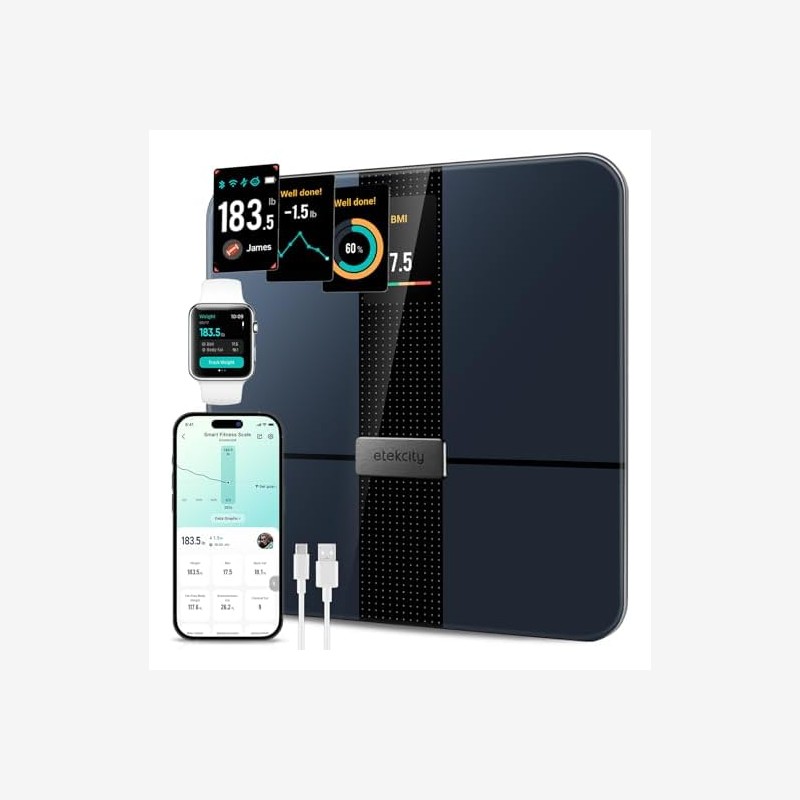
| Model | HPR | Reviews | Price at time of writing | | --- | --- | --- | --- | | Etekcity Smart Scale for Body Weight and Fat, BMI, FSA Eligibl | 9.2 | 350,058 | $64 | | Etekcity Upgraded Smart Scale for Body Weight Fat and BMI, FSA | 9.0 | 151,953 | $40 | | Etekcity Smart Scale for Body Weight, Body Fat and BMI, FSA El | 8.8 | 151,953 | $24 |
One structural note you won't see on a product page: the second and third listings show the same 151,953 review count. Listings that share a review base are not independent evidence, so treat this as closer to two verified data points than three. We'd rather tell you that than pad the table.
How does bioelectrical impedance turn resistance into a body-fat number?
Consumer scales use bioelectrical impedance. A small current passes through your feet, and the algorithm estimates fat from resistance.
Notice what's missing from that chain: any direct observation of fat. The scale never sees fat tissue. It sends a current, reads how much resistance it meets, and applies a formula that was built from population data. Your body-fat percentage is that formula's output. It is a conversion, not a finding.
This matters for how you argue with the number. If your reading jumps, the resistance changed. Something about the conductive path changed. Fat, in the space of a day, did not.
Why do two readings ten minutes apart disagree?
Because the estimate depends on hydration, recent exercise, food and skin temperature. A single reading can move several points without anything meaningful changing about your body.
Run the list against a normal morning. You drank water on the way to the bathroom. You trained last night and you're still carrying fluid. You ate late. Your feet are cold because the floor is cold. Every one of those is an input to the resistance reading, and the algorithm weighs them whether you intended it to or not.
So the disagreement isn't the scale malfunctioning. It's the scale doing arithmetic on different inputs and reporting the result as though nothing changed.
The fix is a fixed condition, not a better scale. Weigh at the same time of day, before eating and drinking, and read the weekly trend rather than the daily number. Same time, same state, same footing. You're not chasing a true body-fat value — you're building a series where the noise is held roughly constant so the direction becomes visible.
One practical check before you buy: confirm the app lets you get your readings out as a list you can actually work with. If the app only shows today's body-fat percentage and buries older entries, you're structurally limited to single readings, which is the least useful thing you can do with this data.
Who gets the worst body-fat estimates?
Foot-to-foot impedance measures mainly the lower body and infers the rest, which is why the error is larger for very lean or very heavy users.
If you're very lean, there isn't much fat for the current path to distinguish, and the formula's output has less to work with. If you're very heavy, the lower-body-centric measurement has to extrapolate further to speak for your whole body. In both cases the number on the display is being carried by inference rather than by the part of you the current actually passed through.
Here's the tradeoff nobody puts in the bullet list: the people who most want a body-fat number — very lean users tracking a cut, very heavy users tracking a change — are the two groups whose scales return the least trustworthy version of it. If you fall in either group, the weekly trend is your only defensible read, and even that is a direction, not a value.
Why the old answer no longer applies
The earlier version of this explainer ranked scales by how closely their body-fat number sat to a laboratory reference. That framing assumed the number was a property of your body being reported with some error, and that a better scale would report it more tightly.
The scale side of that question is largely settled. With review bases at 350,058 and 151,953, and entry pricing at $24, the hardware and the app are not the bottleneck anymore. What hasn't changed is the method: a foot-to-foot current is still an inference about the parts of you it didn't measure, and hydration, food, exercise and skin temperature still move the output several points.
So the ranking criterion moved. The question is no longer "which scale is closest to the true number" but "which scale repeats itself under identical conditions and hands you the series afterward." Repeatability beats absolute accuracy, because a reading that wobbles by several points on its own can't support a decision no matter how close it lands on a good day.
The second update is about scope. We continue to treat the body-fat percentage as an estimate, not a medical metric — no diagnosis, no comparing a single reading from Tuesday against a single reading from last Friday. Two single readings taken under different conditions tell you about the conditions, not about you.
Bottom line
The weight reading is trustworthy; the body-fat percentage is an algorithm's estimate built from foot-to-foot resistance, and it moves with hydration, food, exercise and skin temperature. Lean and heavy users get the widest error, because the measurement covers mainly the lower body and infers the rest. The only way to make the number useful is to hold conditions fixed — same time of day, before eating and drinking — and read the weekly direction instead of the daily value.
Your next action: pick a fixed slot, tomorrow morning before you eat or drink, and start a series. Check that your app lets you export or at least review that list, because a series you can't see is a series you can't read.
FAQ
Is the body-fat percentage on a smart scale a measurement? No. Weight itself is accurate. The body-fat percentage is the estimate, produced by an algorithm that converts resistance from a small current through your feet into a fat figure.
How much can one reading move? A single reading can move several points depending on hydration, recent exercise, food and skin temperature. That swing is the estimate behaving normally, not a fault.
What's the correct way to use one? Weigh at the same time of day, before eating and drinking, and read the weekly trend rather than the daily number. Same time and same state is what makes the series readable.
Why are estimates worse for very lean or very heavy users? Foot-to-foot impedance measures mainly the lower body and infers the rest, so the error is larger for very lean or very heavy users — the formula is extrapolating further from what the current actually passed through.
Do I need a more expensive scale for a better body-fat number? All three models in this month's pool use the same consumer impedance principle, so the error sources travel with the method rather than the price. What your money changes is the rating, the review base and the app — which is why the export question matters more than the dollar figure.


