 Handpicked
Do Hair Dryers Damage Your Hair?
Heat damages hair; the question is how much heat and for how long. Ionic and ceramic claims matter less than the setting you choose.
8 min read
Handpicked Reviews
Written and dated by our editors.
 By Camille DuarteCamille Duarte · Hair Tools EditorPublished in September 2026
Quick answerThe dryer is rarely the culprit — temperature and how you handle soaked hair are. Damage rises with heat, and wet hair is more fragile than dry hair. Hold a lower setting further from the head, use a concentrator, and keep the intake filter clean. Max heat close to the scalp is what actually splits ends.
On this page
- Does a hair dryer actually damage your hair, or is it the heat?
- How does wet hair change the damage equation?
- Why does airflow matter more than wattage on the spec sheet?
- Do concentrator nozzles and attachments actually protect the strand?
- Which hair dryers cleared our bar this month?
- Why has the old "just use a lower heat setting" advice stopped working?
- Bottom line
Does a hair dryer actually damage your hair, or is it the heat?
Start with your hair and the shape you want, because those two things decide how much heat your strands actually have to absorb.
Fine hair is the first to show it. Fewer strands per section means the cuticle warms through fast, so a setting that feels mild on thick hair is already doing work on yours. Dense, coarse hair holds water longer — which is exactly why people reach for maximum heat and then pass over the same section again. That second pass is where the time variable bites. Curly and coily hair adds a third issue: any rough handling while soaked does more damage than the airflow itself.
So, the honest answer: the dryer is the delivery mechanism, not the crime. Wet hair is more fragile than dry hair, and damage rises with temperature. What you're really managing is three things at once — how hot, how close, and how long. A lower heat setting held further from the head is gentler than maximum heat held against the scalp, every time.
How does wet hair change the damage equation?
Wet hair is more fragile than dry hair, so rough towel drying and brushing while soaked cause more breakage than the dryer itself.
That sentence should reorganize your routine. The two minutes before you plug anything in are doing damage you'll later blame on the tool. Rubbing a towel through soaking-wet hair, then dragging a brush through it to "get the tangles out before drying" — that's the breakage. Detangle earlier, while the hair is still coated, and squeeze water out instead of scrubbing it out.
What this means for the strand: if you're seeing short broken pieces around the crown and blaming heat, check your towel technique first. It's free to fix.
Why does airflow matter more than wattage on the spec sheet?
Wattage tells you how much power the motor draws. It does not tell you how much water leaves the strand per second. Airflow does that.
A high-airflow dryer at a moderate setting removes surface water faster than a weak one pushed to maximum heat — and since damage rises with temperature, finishing faster means the strand absorbs less total heat. Same result, less exposure. Low heat only counts as gentler if the airflow is there to make it quick; low heat with weak airflow just means the same section passes under the element twice as many times.
Brushless digital motors run faster and cooler, which is why they dry at lower temperatures than cheap AC motors. That's the mechanism worth looking for, but motor type isn't published for any of the three tools on this month's shortlist, so judge by airflow at the nozzle rather than a wattage number in a listing.
Do concentrator nozzles and attachments actually protect the strand?
Concentrator nozzles direct air along the strand and reduce the time each section spends in the heat. That's the entire mechanism — it's a time saver, not a treatment, and it does nothing for your hair beyond cutting exposure.
Fit the attachment to your density, not to the photo on the box. Dense hair needs a wider nozzle so the airflow actually reaches the section instead of bouncing off it. Fine hair needs a narrow concentrator so the air doesn't scatter the section apart and force you to re-pass. On a brush-style dryer the attachment is built in, which means a fixed barrel size decides your section size for you.
The maintenance item nobody mentions: every dryer pulls room air through an intake filter at the back, and that filter collects lint, dust and styling product. A clogged filter cuts airflow. Reduced airflow forces you into longer time under heat or a higher setting to compensate — so a dirty filter quietly raises your heat exposure without you touching the dial. Clean it. It's the cheapest damage prevention in this entire article.
Which hair dryers cleared our bar this month?
This month only three tools in this category met our threshold, and only two of them are dryers. We'd rather tell you that than pad the list with filler.
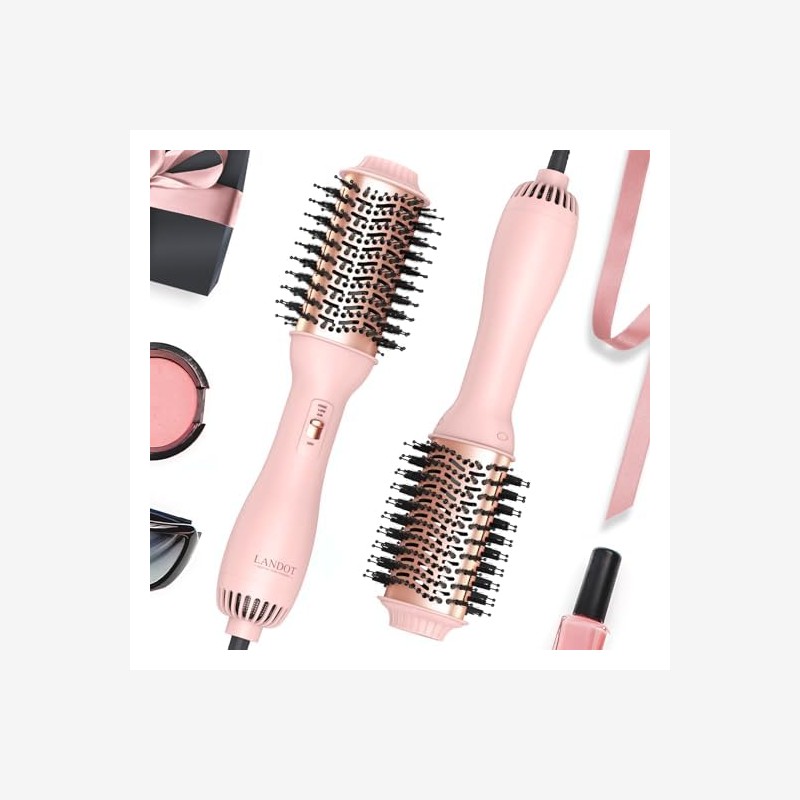
- LANDOT US Hair Blow Dryer Brush 2.4 in Hot Air Styler for Volu — HPR 9.4, 12,013 reviews, $30 at time of writing. Highest score of the three. The 2.4 in head is a fixed section size: fine to medium hair at shoulder length or shorter works with it; very long or very dense hair will fight it.
- LANDOT Hair Blow Dryer Brush One-Step Hot Air Volumizer for Sm — HPR 9.2, 12,013 reviews, $40. Same review base as the model above, $10 more, score a touch lower. Worth understanding what that extra $10 is buying before you pay it.
- US-wavytalk-TF Wavytalk Steam Hair Straightener Steam Sesh for — HPR 9, 1,953 reviews, $60. Not a dryer. It's a steam straightener, which means contact heat rather than airflow, so don't read that 9 as a dryer score. The data we have doesn't list its plate temperature, so we can't place it on the same axis as the two above.
HPR is our own comparison score, not a lab measurement.
Why has the old "just use a lower heat setting" advice stopped working?
The earlier version of this answer was: lower the heat, hold it further away, done. That's half the picture.
Low heat held close to the scalp for a long time is not automatically gentler than medium heat held further away. You keep re-passing the same section, and the strand keeps absorbing. The variables multiply — temperature, distance, dwell time. Drop one and you can afford to raise another; ignore one and the other two can't save you. That's why "I had it on low" isn't a defense if the nozzle was an inch from your part for four minutes.
Second, heat protectant sprays used to be the escape hatch in this advice. They buy some margin but do not make maximum heat safe. "I sprayed something" is not a reason to move the dial to the top.
Third, and this is the one that matters most: very high heat to speed up drying is the usual cause of the split ends people blame on the dryer. If your routine needs the top setting to finish in a reasonable time, the airflow is the problem — not your patience.
Bottom line
The dryer isn't innocent, but it's not the main defendant either. Damage rises with temperature, wet hair is more fragile than dry hair, and the rough towel-and-brush minutes before you plug in do more harm than the airflow. Keep the heat setting lower, hold the nozzle further from the head, use a concentrator to shorten each section's time in the heat, and clean the intake filter on a schedule. If you want a tool from this month's shortlist, the LANDOT US Hair Blow Dryer Brush 2.4 in at $30 carries the highest HPR here — but only if a fixed 2.4 in barrel suits your hair's length and density. Next step: check your filter, then set the heat one notch lower than you think you need and let the airflow carry the drying.
FAQ
Can I just air-dry to avoid the whole problem? Air-drying removes the heat variable, but it doesn't remove the fragility one. Wet hair is more fragile than dry hair, so if you air-dry by rubbing a towel through it and brushing it soaking wet, you've kept most of the breakage and only skipped the drying time. Manage the soaked phase either way.
Does a heat protectant spray make maximum heat safe? No. Heat protectant sprays buy some margin, but they do not make maximum heat safe. Treat them as a buffer, not a permission slip to run the top setting against your scalp.
What temperature setting should I use? There's no universal number we can hand you, and we won't quote one we can't back. What the data supports is the direction: a lower heat setting held further from the head is gentler than maximum heat held close to the scalp. Tune distance and dwell time alongside the dial.
Are blow dryer brushes harder on hair than a regular dryer? The brush and the air outlet are the same object, so the section sits under tension at the same time it's under heat — and the barrel size fixes how big that section is. That's a design fact, not a defect. It's the reason to keep the heat low and let airflow do the drying rather than leaning on the brush to pull the section straight.
How do I know my airflow is weak? Two signs: you keep raising the heat to finish in the same time you used to, and the back of the dryer is warm or dusty to the touch. Both point at a restricted intake filter. Clean it before you blame your technique.


