 Handpicked
Can a 4K Projector Work in Daylight?
Resolution is not the problem, light output is. Here is the number that matters and why it is often inflated.
8 min read
Handpicked Reviews
Written and dated by our editors.
 By Nadia KarimNadia Karim · Projector & Home Cinema EditorPublished in September 2026
Quick answerYes — a 4K projector can hold a usable daytime image, but brightness, contrast and screen choice decide it, not resolution. Three models cleared our bar this month: Dangbei MP1 MAX (3100 ISO Lumens, HPR 9.2, $1,299), DBOX02 (2450 ISO Lumens, HPR 9.4, $1,199) and the portable Atom (HPR 9, $549). On this page - Is 4K pointless in a bright room? - How many lumens do you actually need? - Does an ALR screen beat a brighter projector? - Where can the projector sit? - Which 4K projectors cleared our bar this month? - Why the old answer no longer applies
# Can a 4K Projector Work in Daylight?
On this page
- Is 4K pointless in a bright room?
- How many lumens do you actually need?
- Does an ALR screen beat a brighter projector?
- Where can the projector sit?
- Which 4K projectors cleared our bar this month?
- Why the old answer no longer applies
- Bottom line
Is 4K pointless in a bright room?
Three things about your room decide the answer before any model name gets typed into a search bar: how much light you can actually kill, how far the lens has to sit from the screen, and how big the screen is. A west-facing window with a cheap roller blind is a different room from a basement with a blackout curtain, and the same projector will look like two different products in them.
Here is the part that trips people up. Resolution is not what fails first. A projector in a bright room is competing with ambient light, and the image it loses is contrast — dark scene detail goes grey and flat long before you can see whether the panel is resolving 4K detail. Contrast is what makes dark scenes readable, and it collapses as room light rises. So the 4K badge matters less in daylight than the brightness figure and the screen in front of it.
If you cannot control light at all — a glass-walled living room you use at noon — be honest with yourself that a projector is the wrong display for that wall, and a screen that emits its own light is the correct purchase. Projection is a reflected-light technology, and no spec sheet changes that.
How many lumens do you actually need?
Start by refusing to compare unlike numbers. ISO lumens come from a defined measurement; a listing that just says "lumens" with no standard named is a marketing figure and cannot be stacked against an ISO number. Our picks this month are quoted in ISO lumens, which is the only reason the figures below can be lined up at all.
In our comparison, the Dangbei MP1 MAX Triple Laser 4K is rated 3100 ISO Lumens, and the Dangbei DBOX02 Laser Projector 4K is rated 2450 ISO Lumens. That gap is the headroom you are buying: more output means the projector holds its contrast further into a lit room before the image washes out.
Two things to weigh against that. First, brightness on screen is lumens spread across screen area — the bigger the screen, the dimmer the same projector gets, so a unit that looks strong on a small screen can run thin on a large one. Second, output creates heat, and heat needs fans. Check the noise rating before you mount anything directly above a sofa; a bright projector that you can hear over quiet dialogue is a bad trade in a small room.
Does an ALR screen beat a brighter projector?
Yes, and it is the single biggest upgrade for a daytime room. An ambient light rejecting screen reflects projector light back at the viewer while absorbing light arriving from the sides — which is exactly where your window light comes from. It also costs less than moving up to a projector class you did not need.
The tradeoffs are real and usually undersold. ALR screens are directional: the sweet spot is narrower, so seats far off-axis lose brightness and colour, and a wide-row layout will look uneven. They are also not cheap, and a grey ALR surface costs you some peak brightness in exchange for the contrast it protects. Cheap ALR fabric on a pull-down frame is worse than a plain white fixed screen.
Sequencing matters. Fix the screen and the light control first, then spend what is left on the projector. Buyers who do it the other way round end up replacing the projector to compensate for a screen they should have replaced.
Where can the projector sit?
Throw ratio decides this, and it is simple arithmetic: divide the distance from lens to screen by the width of the screen you want. That single number tells you whether the projector can live on a back shelf, or whether it has to sit close to the wall.
A short throw model can live against the wall and avoids a person walking through the beam — the practical argument that has nothing to do with image quality. On a coffee table in front of the seats, a conventional long-throw unit will blind anyone crossing the room, and no amount of brightness fixes a shadow puppet show.
Then there is keystone correction. Digital keystone rescales the image to square it up when the projector is off-axis, and it does that by throwing away pixels and softening edges. It is a rescue tool, not a setup plan. Get the lens roughly centred and level mechanically, use as little keystone as the room allows, and treat optical shift as the feature worth paying for.
Which 4K projectors cleared our bar this month?
Only three models in our pool met the bar for a room with controllable light, so this is a short list by design rather than a long one padded out.
Dangbei MP1 MAX Triple Laser Projector 4K — 3100 ISO Lumens, HPR 9.2, 92 reviews, $1,299 at the time of writing. The brightest of the three on paper, and the one to look at first if your screen is large or your blind is imperfect. Its 92 reviews make it the thinnest evidence base here; treat the score as promising rather than settled.
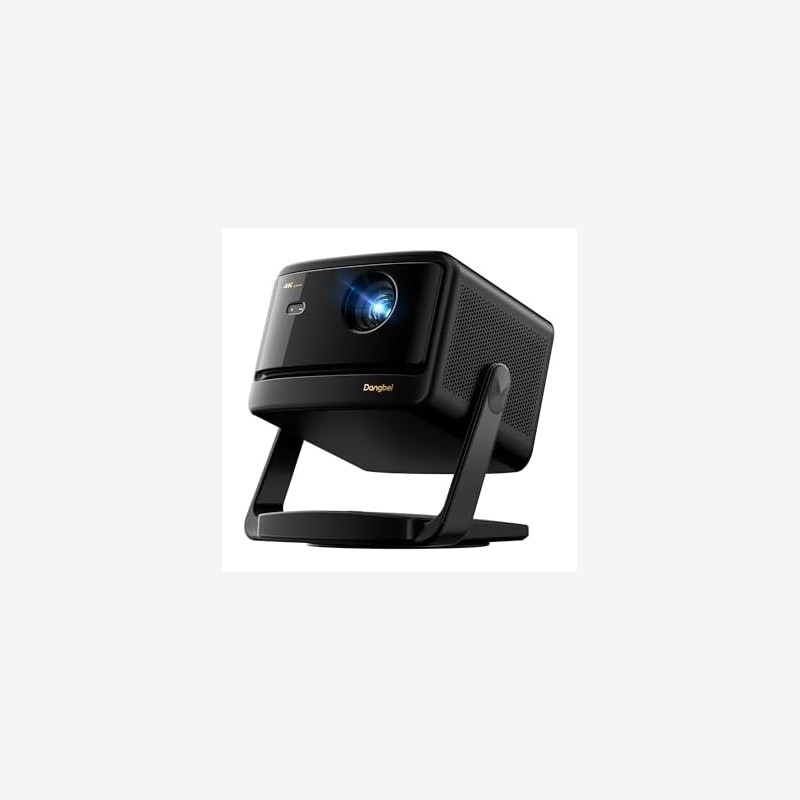
Dangbei DBOX02 Laser Projector 4K GTV — 2450 ISO Lumens, HPR 9.4, 409 reviews, $1,199 at the time of writing. The highest HPR of the three and by far the largest review base at 409 reviews. The 2450 ISO Lumens figure is the limit to accept: fine in a room you can darken, thin at midday with a bright screen.
Dangbei Atom Portable Laser Projector, Google TV — HPR 9, 300 reviews, $549 at the time of writing. The entry point, and portable rather than installed. Its brightness is not quoted in ISO terms in what we compared, so it does not belong in a like-for-like daylight ranking against the two above. Buy it for moving room to room, not for fighting a sunlit window.
Why the old answer no longer applies
The old rule was blunt: projectors need a dark room, so resolution is the only spec worth arguing about, and lamps are what you replace every couple of years. Two changes broke that.
Light sources changed. Laser and LED hold their brightness longer than lamps and reach full output instantly, so a 4K laser projector does not need a warm-up ritual before it fights ambient light. The replacement-cost argument that used to punish bright projectors has largely gone with it.
Screens and sitting position changed. ALR surfaces are now a mainstream purchase rather than a custom install, and short throw models let a projector live against the wall in rooms that could never host a ceiling mount.
What did not change is physics. Ambient light still costs contrast, and an ALR screen is still directional. The honest update to the old answer is not "daylight is fine now" — it is "daylight is workable in a room you have prepared, and a bad idea in a room you have not."
Bottom line
A 4K projector works in daylight when the room is prepared for it: light you can reduce, a screen that rejects side light, and a lens position that suits your throw distance. Brightness and contrast get you there; resolution is the last thing you notice and the first thing marketing leads with. Among the three models in our pool, the MP1 MAX's 3100 ISO Lumens suits brighter rooms and larger screens, the DBOX02 pairs the highest HPR with a 409-review base at a lower 2450 ISO Lumens, and the $549 Atom is a portable, not a daylight solution. Next step: measure your throw distance, work out the screen width you want, and price an ALR screen before you price a projector — that order will save you a return.
FAQ
Can any 4K projector work in direct daylight?
No. Direct sun on the screen beats any consumer projector's output. What works is daylight in a room with a blind you can close and an ambient light rejecting screen; full sun on the screen surface is not a setup problem you can buy your way out of.
Do I need an ALR screen if I already have blackout curtains?
Not necessarily. If you can darken the room properly, a fixed white screen gives you more even brightness across wider seating. ALR earns its price when you want to use the room with some light on, and you accept the narrower viewing window that comes with it.
Is 4K resolution useless in a bright room, then?
Not useless — third in line. Brightness determines whether the image survives ambient light, contrast determines whether dark scenes stay readable, and resolution determines how much fine detail you can see once the first two are handled. A dim 4K projector in a lit room shows you less than a bright one would.
Are laser projectors brighter than lamp projectors?
Laser and LED sources hold their rated brightness longer than lamps and reach full output instantly, which matters more than the first-hour number. That said, the figure that decides your room is the ISO lumen rating, regardless of which light source produced it.
Which of the three should I buy for a room with one bright window?
The MP1 MAX at 3100 ISO Lumens, if the window is the room's main problem and you accept a 92-review evidence base. If you can shut that window down, the DBOX02's 2450 ISO Lumens and HPR 9.4 on 409 reviews is the better-evidenced pick at $1,199.


