 Handpicked
How Far Can a Mobility Scooter Go on One Charge?
Range claims assume a light rider on flat ground. Hills, weight and cold weather cut it, sometimes in half.
8 min read
Handpicked Reviews
Written and dated by our editors.
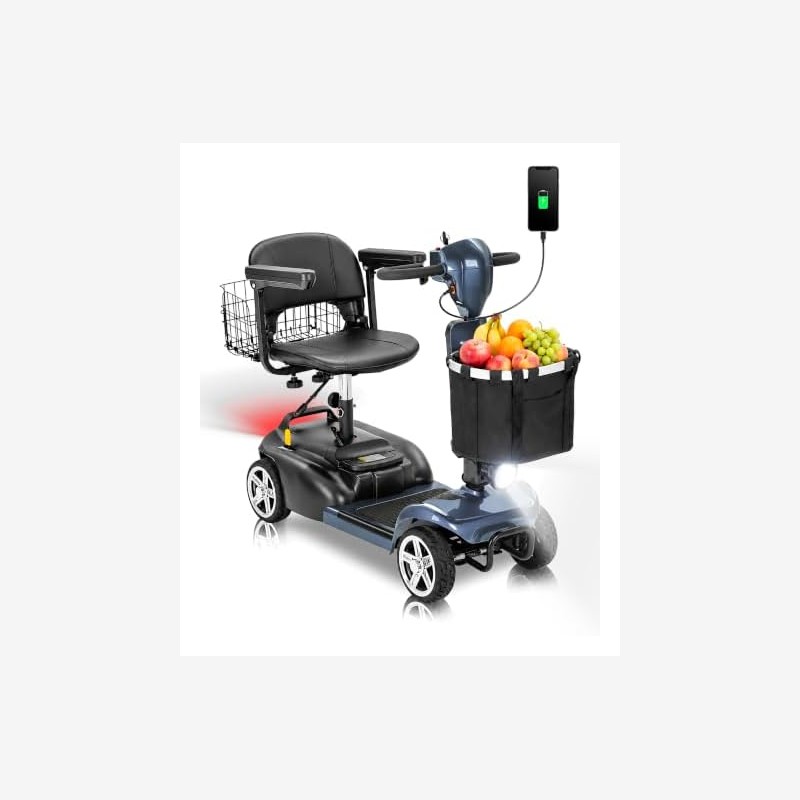
Quick answerAdvertised range assumes an ideal rider, level ground and moderate speed. Add your own weight, a hill, grass, stop-start riding or a cold morning and you get less — sometimes much less. Plan around your shortest regular trip, not the number on the box.
On this page
- What's in this guide
- How much range do you actually need for how you leave the house?
- Why does the advertised range never match real life?
- Lithium or sealed lead acid — which pack still has range in year three?
- Can one person get it into the trunk without help?
- Do wheel size, ground clearance and turning radius matter more than top speed?
- Why the old answer no longer applies
- Bottom line
What's in this guide
- How much range do you actually need for how you leave the house?
- Why does the advertised range never match real life?
- Lithium or sealed lead acid — which pack still has range in year three?
- Can one person get it into the trunk without help?
- Do wheel size, ground clearance and turning radius matter more than top speed?
- Why the old answer no longer applies
How much range do you actually need for how you leave the house?
Two questions come before any spec sheet. How do you leave the house — do you drive and load the scooter yourself, take a bus or train, or ride only the streets around your building? And when the scooter has to travel in a car, who lifts it: you, alone, or someone who isn't always there?
Those two answers narrow the list faster than any range figure. A rider who loops the neighborhood and comes home to a garage outlet needs far less capacity than someone who rides to a bus stop, folds the scooter and lifts the heaviest piece onto a rack in the rain. The first rider can buy for comfort and stability. The second has to buy for the lift, and everything else is secondary.
One note on method: we compare published specs and owner feedback, and we score what we can verify. We don't run lab range tests, so every range figure in this article is a claim to check against your own route, not a measurement we took.
Why does the advertised range never match real life?
Published range is calculated under friendly conditions: an ideal rider weight, level ground, moderate speed. Change one variable and the number drops. Change three at once — a loaded basket, a hill on the way home, a cold morning — and it can drop a long way.
What draws extra current:
- Your weight plus whatever you're carrying
- Hills, including the gentle ones you stop noticing
- Grass, gravel and unpaved paths
- Repeated stops and starts, which is most city riding
Cold is its own problem: low temperatures reduce usable battery capacity, so the same trip is shorter in January than in May even on a healthy pack. If your regular route sits close to the limit of the claimed range, you don't have enough range. Buy headroom.
Lithium or sealed lead acid — which pack still has range in year three?
This is the question behind the range question. Chemistry decides how the pack ages. Lithium packs hold their capacity over time and charge faster. Sealed lead acid packs are heavier and cheaper — you pay twice, once at the register and again on every lift.
Three habits that protect whatever you buy:
- Charge fully before storage, and never leave a pack flat for months.
- Store it charged, then top it up before the season starts.
- If you can't lift the scooter with the pack in it, the pack's weight is part of your lifting problem, not just a line on a spec sheet.
Hills, cold and heavier riders shorten lithium range too. Chemistry changes how fast the pack degrades, not whether physics applies to you.
Can one person get it into the trunk without help?
This is where most buying decisions actually fail. A scooter that has to be lifted must be judged by the weight of its heaviest single piece, not its total weight — and many listings don't publish that number. If you can't find it, you're buying blind on the one spec that decides whether the scooter ever leaves your street.
Three models cleared our bar this month, all Ecomobi, all showing 215 reviews — an identical count across all three, which means the review count isn't sorting them for you:
- Ecomobi AMZ Mobility Scooter for Seniors & Adults, 4 Wheel Fol — HPR 9.3, 215 reviews, $920 at the time of writing
- Ecomobi AMZ Light Weight Mobility Scooter for Adults, 3 Wheel — HPR 9.1, 215 reviews, $1,200 at the time of writing
- Ecomobi AMZ Light Weight Mobility Scooter for Adults, 3 Wheel — HPR 9.0, 215 reviews, $1,200 at the time of writing
Two of those listings share a name and a price and differ by 0.1 on HPR. Match the model number, not the title, or you'll order the wrong one. Before any of them goes in a trunk, measure the threshold you have to cross, the slope of your ramp and the inside of your elevator. A folded scooter that fits the trunk but not the lift shaft is still stuck indoors.
Do wheel size, ground clearance and turning radius matter more than top speed?
For daily use, yes. Ground clearance and wheel size decide whether the scooter handles kerbs and gravel, and that matters more than top speed — a scooter that can't cross the lip at the end of your driveway is slow in the only way that counts.
Three specs to check against your real routes:
- Turning radius, which decides whether you can turn around in a hallway, a lift lobby or a narrow shop aisle.
- Seat height adjustment, so your feet reach the floor at stops and your hands reach the tiller without leaning forward.
- Ground clearance and wheel diameter, measured against the kerbs, gravel and door thresholds you meet every week.
Take the tape measure to your tightest doorway before you take it to the checkout.
Why the old answer no longer applies
An earlier version of this article ranked scooters by top speed and the range printed on the box. Two things broke that approach.
Range claims aren't comparable between brands. Ideal rider weight, test surface and speed are chosen by the maker, and none of them is your street, so a single number can't be stacked against another listing's number.
The deciding spec moved as well. More riders now load a scooter into a car alone, which makes heaviest-piece weight the number that matters, not total weight. Battery chemistry changed the long game too: a lithium pack and a sealed lead acid pack carrying the same claim don't age the same way.
And our pool was thin this month. Three models met the bar, all from one brand, all with the same review count. We'd rather tell you it's three than pad the page with eight.
Bottom line
Range is a claim, not a guarantee — the honest working figure is your shortest regular trip plus margin. Judge a scooter by its heaviest piece, its turning radius and its battery chemistry, then check the price against the route you actually ride. If the fold-and-lift step fails, nothing else on the spec sheet rescues the purchase.
Next step: write down your two most common trips and the lift you have to make at each end, then measure your doorway, ramp and trunk opening. Take those numbers shopping, not the range on the box.
FAQ
Can I trust the range printed on the box?
Treat it as an upper bound, not a plan. It assumes an ideal rider weight, level ground and moderate speed. Your weight, hills, grass and repeated stops all draw more current, and cold weather cuts usable battery capacity on top of that. If your regular trip is close to the claimed figure, you don't have enough margin.
Does cold weather really cut range?
Yes. Low temperatures reduce usable battery capacity, so the same route costs you more in winter than in summer, even with a healthy pack. A pack that is already aging suffers more. If you ride year-round, buy more headroom than your summer route needs.
How should I store the battery over winter?
Charge it fully before storage, store it charged, and never leave it flat for months. Top it up before the season starts. Leaving a pack drained for a long stretch is one of the fastest ways to lose capacity permanently.
Is a 4-wheel scooter harder to lift into a car than a 3-wheel one?
Not automatically. Wheel count doesn't tell you what the heaviest single piece weighs, and that's the number your back deals with. Look for a listing that publishes heaviest-piece weight; if it doesn't, assume you can't verify the lift before the scooter arrives.
Do I need lithium if I only ride short trips?
Not necessarily. If you store the scooter in a garage and ride short loops, a sealed lead acid pack can be enough, and it costs less up front — but you carry its extra weight on every lift, and it will lose capacity sooner. Decide by how you charge and lift it, not by the range claim.


