 Handpicked
Do Jump Starters Work on a Completely Dead Battery?
Usually yes, if the battery is discharged rather than failed. The difference is whether the car keeps running after you disconnect.
8 min read
Handpicked Reviews
Written and dated by our editors.
 By Marcus ReedMarcus Reed · Roadside Gear EditorPublished in September 2026
Quick answerYes — a lithium jump starter can crank an engine whose battery is too flat to turn over, because the pack supplies the cranking current itself. It cannot rescue a battery that is frozen, damaged or shorted internally. If the engine dies the moment you unclip the pack, you need a new battery, not another jump.
On this page
- In This Article
- Can a Jump Starter Start a Car With a Completely Dead Battery?
- Why the Peak Amp Number on the Box Doesn't Tell You Much
- What's the Right Order of Steps When You're Stranded?
- When Should You Not Jump the Car at All?
- Why the Old Answer No Longer Holds Up
- Bottom Line
In This Article
- Can a jump starter start a car with a completely dead battery?
- Why the peak amp number on the box doesn't tell you much
- What's the right order of steps when you're stranded?
- When should you not jump the car at all?
- Why the old answer no longer holds up
- Bottom line
Can a Jump Starter Start a Car With a Completely Dead Battery?
January, underground garage, you press the button and get a dim flicker and a click. Nothing cranks. The useful question in that moment isn't whether the pack is any good — it's whether the battery in front of you is flat or finished.
Those are two different problems, and only one of them is a jump starter's job. A lithium jump starter can start a car whose battery is too flat to crank, because it supplies the cranking current itself. It isn't topping the battery up. It's standing in for it for the length of one start.
The split you have to make at the roadside:
- Flat but intact. The pack starts it, the engine runs, the alternator recharges the battery, you drive on and get the battery load-tested soon.
- Failed. The pack starts it, you unclip, the engine dies. That isn't a jump problem. The battery is not holding charge and needs replacing.
Buying a bigger pack doesn't move you from the second case to the first.
Why the Peak Amp Number on the Box Doesn't Tell You Much
4000A. 3000A. Peak amp claims are marketing numbers. What matters is whether the pack can deliver cranking current at cold temperatures — the exact condition you're standing in when you need it.
Peak is a momentary figure taken under friendly conditions. Your engine asks for its cold cranking amps on a freezing morning, and a lithium pack that has spent the night in a cold car will not hand you the same current it showed on a bench. So when you compare packs, don't buy the biggest number on the front. Check that the pack is rated for a 12V car battery, that the jumper port is one you can get to with cold hands, and — the one people forget — that the leads will physically reach your battery posts. Measure the run from where you'd actually set the pack down (floor, engine bay ledge, boot lip) to the terminals. Short leads on a battery buried behind a strut brace turn a working pack into an expensive brick.
This month's shortlist is thin, and I'd rather say so than pad it. Three packs cleared our threshold, all with a 12V jumper port:
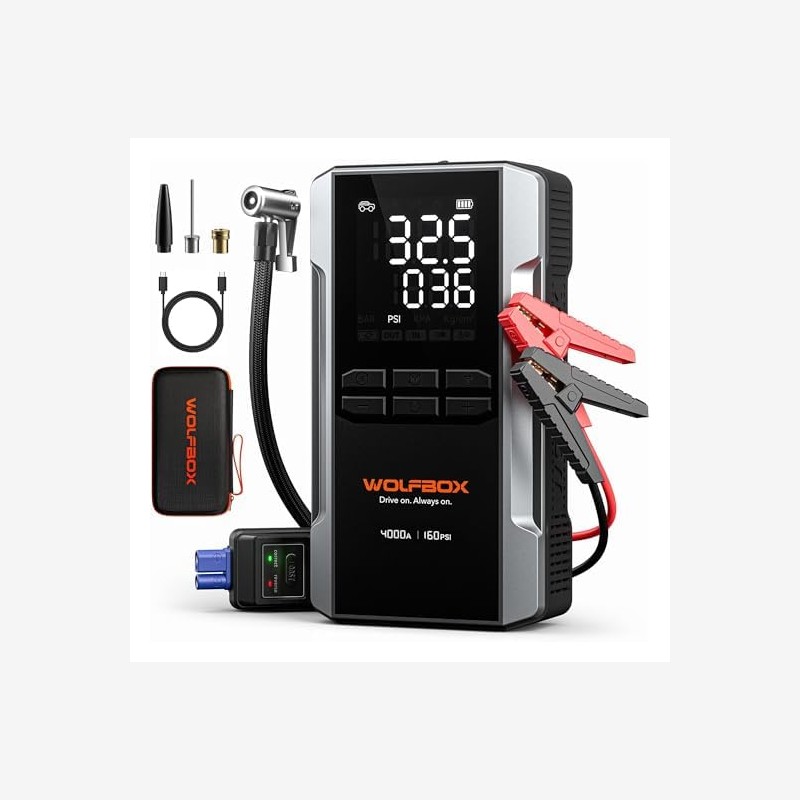
- WOLFBOX MV24A 4000A with 160PSI air compressor — HPR 9.4, 2,271 reviews, $210 at the time of writing
- WOLFBOX MV16A 3000A with air compressor, 59.2Wh — HPR 9.2, 1,637 reviews, $173
- WOLFBOX 4000A, 12V car battery jumper starter port — HPR 9, 6,044 reviews, $147
Three models, one brand. Treat that as a shortlist, not a survey of the market.
What's the Right Order of Steps When You're Stranded?
Order matters more than the pack you bought.
Step 1 — Look before you clip. Check the battery case for swelling, cracks or leaks. If it's physically damaged, frozen or shorted, stop here. Don't jump it.
Step 2 — Position, then clip. Set the pack somewhere stable, not balanced on a moving part. Red to positive, black to negative or to a ground point. Confirm the leads reach before you commit to the position.
Step 3 — Power the pack on, then crank. Short bursts rather than long grinding, so you're not dumping current into a starter that isn't turning.
Step 4 — Unclip once it's running steadily. Then watch the dash. If the engine dies as soon as the pack is disconnected, the battery is not holding charge. Stop jumping it and start pricing a replacement.
Step 5 — Recharge the pack when you get home. A pack you used once and threw back in the boot is a pack that won't help you twice.
The compressor is a bonus, not the reason to buy
Most of these packs also inflate tyres. The compressor duty cycle is short, so let it cool between tyres — one tyre, cool down, next tyre. Don't chain all four. And remember that inflating four tyres pulls the pack down; if you need a jump later the same week, you've spent the reserve. A 160PSI figure is a rating, not a statement about how fast the pump fills or how close it lands to your target. If the exact pressure matters, check with a separate gauge.
Where the pack lives between jumps
Store the pack at partial charge in a car that sees temperature extremes — not full, not flat. Heat is what kills lithium cells, so a pack that bakes in a hot boot all summer will not be the pack you bought. Top it up at the start of cold season, and again if it's been sitting. A jump starter with nothing in it is just a heavy box with clips.
When Should You Not Jump the Car at All?
- Physically damaged battery. Cracked case, leaking, swollen — a jump pushes current into something that can't accept it safely.
- Frozen battery. A frozen battery may already be damaged internally. Don't jump it; get it indoors or get help.
- Shorted battery. Same answer. This is a tow, not a jump.
- A battery that keeps dying. If you've jumped it twice in a month, the pack is masking a failing battery, a charging fault or a parasitic drain. Fix the cause.
None of these are pack failures. They're cases where the pack isn't the right tool, and knowing the difference is what keeps a jump starter from being a bad purchase.
Why the Old Answer No Longer Holds Up
The older advice was simple: jump starters were for a lightly discharged battery, and a car that wouldn't crank at all meant cables and a second vehicle, or a tow. That advice came from lead-acid booster boxes that were heavy, self-discharged, and couldn't deliver much.
Lithium packs changed the arithmetic. They supply the cranking current themselves, which puts "too flat to crank" inside their range. Two knock-on changes matter. First, packs now carry compressors and lights, so the thing in your boot does more than one job — and has more than one way to drain. Second, the failure most people actually meet isn't a flat battery, it's a failed one, and no pack fixes that. The updated answer is narrower and more useful: a jump starter covers a discharged battery, not a dead one.
Bottom Line
A jump starter will start a car whose battery is too flat to crank, because the pack supplies the cranking current itself, and it will do it in a garage at 6 a.m. with nobody around to help. What it won't do is fix a battery that has failed — if the engine dies the moment you unclip the pack, the battery is not holding charge and needs replacing. It also won't help a battery that's frozen, damaged or shorted; that's a tow. Cold is the honest test of any pack, and peak amp numbers won't tell you how one behaves on a freezing morning.
Next step: find the cold cranking amp rating on your battery label, measure the run from where you'd set a pack down to the terminals, then choose from the three above — the $147 jumper-only model if you already own a tyre pump.
FAQ
Will a jump starter start a car with a completely dead battery?
It depends on what "dead" means. If the battery is too flat to crank but still intact, yes — the pack supplies the cranking current itself. If the battery is frozen, physically damaged or shorted internally, no: don't jump it at all.
How do I tell whether my battery is flat or failed?
Start it with the pack, let it run, then disconnect. If the engine keeps running, the battery was discharged and the alternator is recharging it. If the engine dies as soon as the pack comes off, the battery is not holding charge and needs replacing.
Can I jump a frozen battery?
No. A frozen battery may already be damaged internally, and pushing current into it is not something to do at the roadside. Get it to a warm space or call for help.
Do I need to charge the jump starter before I use it?
Yes. Store the pack at partial charge and top it up before cold season — a pack stored flat in a car that sees temperature extremes may have nothing left when you need it. Heat is what kills lithium cells, so where it lives matters as much as how often you charge it.
Does the air compressor change which pack I should buy?
Only if you'd otherwise carry a separate pump. The compressor duty cycle is short, so let it cool between tyres, and inflating four tyres drains the pack. Buy for the jump first; treat the inflator as a bonus.


