 Handpicked
Can a Carport Survive High Wind?
Only if it is anchored properly. A canopy staked into grass will fly; the frame is rarely the weak point.
8 min read
Handpicked Reviews
Written and dated by our editors.
Quick answerMost carports fail at the anchor, not the frame. A canopy or steel carport staked only into grass will lift in serious wind. Concrete anchors, asphalt anchors or ground screws hold it down. Canopies usually carry a wind rating only; steel carports carry wind and snow ratings — and often need a permit.
# Can a Carport Survive High Wind? What Holds It Down, What It's Rated For, and When You Need a Permit
On this page
- What wind speed can a carport survive?
- Does the anchor or the frame decide whether it stays down?
- Canopy or steel carport: which one is rated for wind and snow?
- Do I need a permit for a carport?
- Why the old answer no longer applies
- Bottom line
What wind speed can a carport survive?
Start with your ground, not the catalog. Three site facts decide the answer before any spec sheet matters: what the surface is (grass, gravel, asphalt, concrete), how exposed the spot is (open field, gap between two buildings, coastal), and how much snow sits there in a normal winter.
A carport in this category carries a wind rating, and that rating describes the frame and cover as one unit in a defined setup. It is not a promise about your yard. The same canopy that holds on a slab in a sheltered garden behaves like a sail on open grass. Uplift is the failure mode, not crushing: wind gets under the roof panel and pulls the structure up and sideways, so legs that were perfectly steady in still air become levers against their own anchors.
Snow is the second half of the question, and it is where the two product families split. Canopies carry a wind rating and rarely a snow load. Steel carports are rated for both. If your winter snow depth is measured in feet rather than inches, that single line in the spec table settles the argument for you — a canopy becomes a seasonal cover you clear after every storm, not a building you leave standing.
So the honest answer to "what wind speed can it survive" is: whatever the published rating says, minus whatever your anchor plan fails to deliver. The rating is the ceiling of the test. The anchor is the ceiling of reality.
Does the anchor or the frame decide whether it stays down?
The anchor. Every carport in this category will fail in serious wind if it is only staked into grass. Those thin stakes in the box hold the frame while you assemble it — they are not an anchor system, and treating them as one is the most common mistake we see in this category.
What actually holds it:
- Concrete anchors into an existing slab or a new pad. Highest holding power, and the pad also stops the legs from settling at different rates.
- Asphalt anchors where you have a driveway surface. Correct for the material, but they load a surface that flexes in heat, so check them each season.
- Ground screws for grass and gravel. They reach below the frost-affected layer and can be removed later. This is the option for anyone who cannot pour concrete.
Frame wall thickness matters next, and it is the number most listings bury. Ask for the tube wall thickness in gauge or mm, and look at how the leg meets its base plate — that joint is where a thin-wall tube develops play at the bolt holes. A heavy cover on a light frame with three ground screws is a worse bet than a moderate cover bolted through a slab.
Practical rule from the site conditions out: define your worst-case wind exposure and snow depth, pick the anchor for the surface you actually have, and only then compare frames.
Canopy or steel carport: which one is rated for wind and snow?
Two models in this batch cleared our threshold, and we would rather say that than pad the list — the overlap of a stated load rating and enough review volume to score is small in this category.
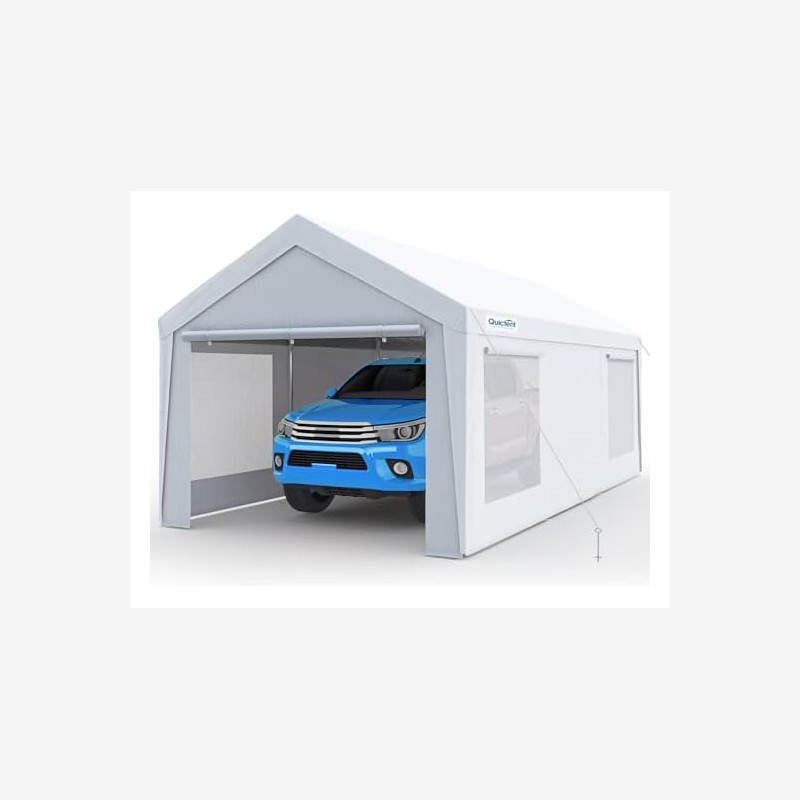
Quictent 20x20 Heavy-Duty Two-Car Canopy — HPR 9.2, 534 reviews, $460 at the time of writing. A 20x20 footprint covers two cars side by side. The review base is large enough that patterns show up rather than one-off complaints. Read the spec as a wind-rated canopy: no snow rating, so it belongs where winters are mild or where you are willing to clear the roof during and after a storm.
GarveeLife 13x26x11 Steel Carport — HPR 9.0, 165 reviews, $1,000 at the time of writing. The 13x26x11 dimensions give a narrower, longer bay than the Quictent, and the steel frame is the reason to pay roughly double: steel carports are rated for wind and snow, canopies are not. The review count is smaller, so treat the score as solid but less battle-tested than the canopy's.
Which one disappoints whom: the canopy disappoints anyone in a snow-depth region who wanted to stop thinking about the roof. The steel carport disappoints anyone who assumed $1,000 bought the whole job — the price is the frame, and the anchors and, in many places, the permit are on top.
Do I need a permit for a carport?
Often, yes. Many jurisdictions treat a permanent steel carport as a structure that needs a permit. That classification usually turns on whether it is anchored down permanently, whether it is attached to another structure, and how much ground it covers — which is exactly why the 20x20 canopy and the 13x26x11 steel carport are not interchangeable in the paperwork, even though they both shelter two cars.
Before you order, call the building department with three details: the footprint, the anchor type, and whether the unit is freestanding. Setbacks from the property line, and in some places from the street, apply to the covered area, not just to the posts. Then keep the anchor inspection in mind — a carport that no one can inspect because it is staked in grass is the version that creates the problem later.
For the canopy, the same questions apply whenever it stays up through a season. A cover that goes up in spring and comes down in autumn is treated differently in most places from a structure that is permanently anchored.
Why the old answer no longer applies
The old advice was simple: buy the heaviest canopy you can afford and you are done. That answer assumed the ground under it would cooperate, that snow would slide off, and that nobody would ask what it was anchored into.
None of those three assumptions hold up. The anchor list — concrete, asphalt, ground screws — is now the deciding factor, because a canopy or steel carport staked into grass fails in serious wind no matter how thick the tube is. Snow ratings changed the product split, since canopies rarely carry one and steel carports are rated for both. And the permit question moved from the margins to the front of the buying process in many jurisdictions, because a permanent steel carport is treated as a structure.
Prices also move. The figures here are what we saw at the time of writing, and a $460 canopy or a $1,000 steel carport can look very different a season later.
Bottom line
The frame is the visible half of this decision; the anchor is the half that decides whether the carport is still standing after a real storm. Concrete anchors, asphalt anchors or ground screws are what hold it down — grass stakes are assembly hardware, not anchorage. Canopies carry a wind rating and rarely a snow load; steel carports are rated for both, which is most of what the $1,000 GarveeLife buys over the $460 Quictent. And in many jurisdictions a permanent steel carport needs a permit, so the price of the frame is not the price of the project.
Next step: write down your surface type, your worst-case wind exposure and your normal winter snow depth, then match the anchor to the ground and the rating to the snow. Order nothing until the building department tells you which footprint is allowed.
FAQ
Can a carport survive a hurricane?
Not on grass stakes. Every carport in this category will fail in serious wind if it is only staked into grass. With concrete anchors, asphalt anchors or ground screws matched to the surface, and a frame whose published wind rating covers the exposure, you are giving it a real chance — but no anchor plan makes a canopy equivalent to a rated building.
Can I set up a carport on grass?
Yes, with ground screws rather than stakes. Ground screws hold in grass and gravel and can be pulled later, which suits renters and anyone who cannot pour concrete. Staked into grass, the same shelter lifts in serious wind regardless of how heavy the frame is.
Do canopies handle snow?
Rarely. Canopies carry a wind rating and rarely a snow load, so a heavy winter means clearing the roof during and after each storm. If your normal snow depth is significant, a steel carport — rated for wind and snow — is the only one of the two that fits the site.
How do I know if my carport needs a permit?
Assume it does until the building department says otherwise. Many jurisdictions treat a permanent steel carport as a structure that needs a permit, and the deciding details are the footprint, the anchor type and whether it is attached to anything. Call before you order, not after delivery.
How many anchors does a carport need?
Follow the manufacturer's anchor schedule for the surface you have, and do not mix types on one frame. The count depends on the footprint and the exposure, and the anchor type depends on whether you are drilling into concrete, bolting into asphalt or screwing into soil.


