 Handpicked
Can a Portable Power Station Run a Fridge?
Usually yes, and the number that decides it is surge watts, not capacity. Here is how to size it before you buy.
8 min read
Handpicked Reviews
Written and dated by our editors.
 By Ruben OrtizRuben Ortiz · Portable Power EditorPublished in September 2026
Quick answerYes — if you size it by surge first, not by watts alone. A full-size fridge runs at about 100–150 W and surges to 300–500 W when the compressor kicks in. A 1,000 Wh station carries a 100 W load for roughly ten hours on paper, less once conversion losses land.
On this page
- What does a fridge actually draw, and what else is on the plug?
- How long will a 1,000 Wh station run a fridge?
- Why does the surge watt decide whether it works?
- Which power stations fit a fridge load?
- What about plugging the fridge into house wiring?
- Why the old answer no longer applies
- Bottom line
What does a fridge actually draw, and what else is on the plug?
Start with the list, because the station doesn't care what the fridge is for — it cares what is plugged in at the same time. Write it down before you look at any spec sheet:
- Full-size fridge: about 100–150 W running, 300–500 W at compressor start-up
- 12 V compressor fridge: often under 60 W
- Everything else on the same station: lights, a router, chargers, a fan
That last line is where most people get burned. A fridge alone is one number. A fridge plus three other things is a different number, and the station has one budget for all of it.
Two figures matter on the fridge itself. Running watts tell you how fast the battery drains. Surge watts tell you whether the compressor starts at all. They are not the same number, and a compressor can draw about three times its running watts in that first moment.
How long will a 1,000 Wh station run a fridge?
The only formula you need: watt-hours ÷ watts = hours.
Run it on a full-size fridge:
- 1,000 Wh ÷ 100 W = about 10 hours
- 1,000 Wh ÷ 150 W = about 6.6 hours
Now run it on a 12 V compressor fridge at 60 W:
- 1,000 Wh ÷ 60 W = about 16.6 hours
Three things bend those numbers, and they bend in opposite directions. Conversion losses — the inverter turning battery DC into wall-style AC — eat part of every watt-hour before the fridge ever sees it, so real runtime lands under the paper figure. A fridge compressor also cycles off and on rather than pulling its running watts every second, which stretches runtime back out. And cold room temperature, a warm fridge, or a door opened a lot all push consumption up.
Plan with the paper number and expect less. If ten hours is the minimum you need, buy for twelve.
Why does the surge watt decide whether it works?
Because a station that can't start the compressor gives you zero hours, no matter how big the battery is.
Take a fridge running at 100 W. Three times that is about 300 W at start-up. At 150 W running, you're looking at roughly 450 W — which is why the surge band for a full-size fridge lands at 300–500 W. Your station's peak output has to cover that, and it has to cover it *while* everything else is still plugged in. Fridge surge plus a router plus lights is the load the peak rating has to clear.
Then check how long the peak holds. Continuous and peak ratings are different specs, and a station that advertises a peak may only hold it for a moment. That's fine — a compressor surge is momentary. What isn't fine is a peak rating that assumes nothing else is drawing.
Which power stations fit a fridge load?
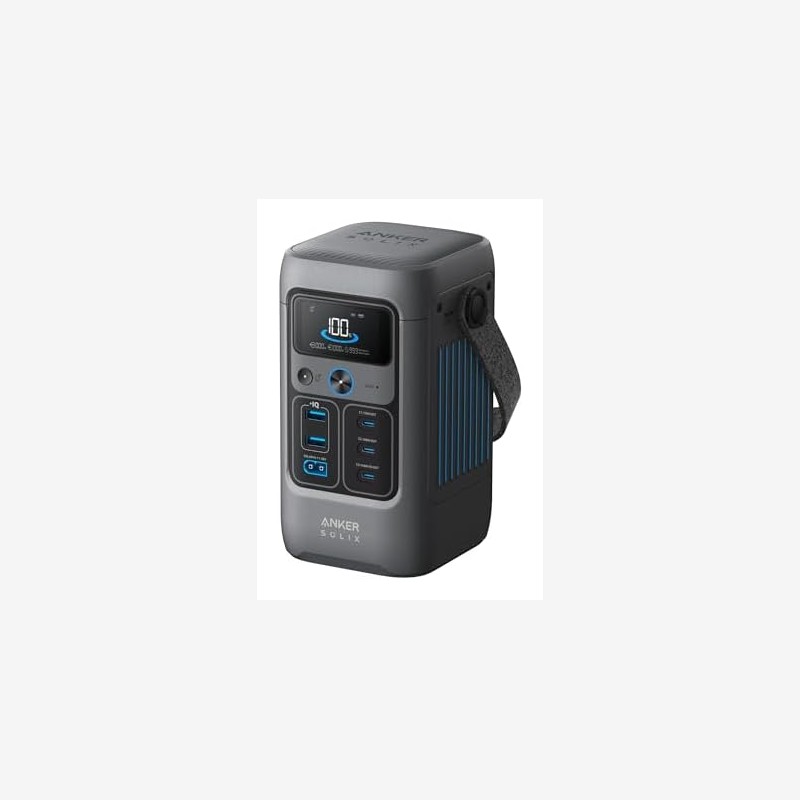
In our data this month, three Anker SOLIX units sit in the range people ask about, and only three — we'd rather list a short row than pad it with models we can't score.
| Model | HPR | Reviews | Price | |---|---|---|---| | Anker SOLIX C1000 | 9.3 | 2,124 reviews | $450 at writing | | Anker SOLIX C1000 Gen 2 | 9.0 | 1,630 reviews | $530 at writing | | Anker SOLIX C300 | 9.1 | 431 reviews | $380 at writing |
Do the arithmetic before the comparison. The Gen 2 costs $530 against the original's $450 — $80 more — and scores 0.3 lower on our HPR scale, with 1,630 reviews behind it instead of 2,124. That's not a reason to avoid it, but it is a reason to ask what the extra $80 is buying for your load list specifically.
The C300 is the cheapest of the three at $380, and the thinnest evidence base at 431 reviews. It's also the smallest capacity class of the three by model number, so if your list is anchored by a full-size fridge and its 300–500 W start-up, that's the one I'd hesitate on. If your list is a 12 V compressor fridge at under 60 W plus a few small loads, the math changes completely in its favor.
One disclosure: HPR is our scoring composite, not a timed discharge test. We don't run lab tests. We compare published specs, price, and what reviewers report, and we score from that.
What about plugging the fridge into house wiring?
It doesn't work the way people hope. Anything wired into house wiring needs a transfer switch — a proper, installed changeover. Running a cord from a station to the fridge is one thing; energizing a circuit in your panel is another, and it's the one that hurts people.
So the honest framing is narrow: a power station runs an appliance you plug into it. It does not run your home's circuits. Anyone telling you a single unit covers the whole house is selling, not sizing.
Aviation is the other boundary worth knowing, because it's measured in watt-hours, not watts. Check your carrier's per-battery limit before you buy a station with travel in mind — the capacity number is the one that follows you to the gate.
Why the old answer no longer applies
The old version of this question was answered with one figure: watts. "Does it put out enough?" That got people buying stations that started the fridge and then died in four hours.
What changed is that the runtime number and the start-up number got separated in the specs. Capacity is watt-hours. Runtime is capacity divided by load. Surge is a separate, published figure, and for a fridge it's about three times running watts — 300–500 W for a unit that idles at 100–150 W.
The second change is the 12 V compressor fridge. Under 60 W running means a 1,000 Wh station stretches to roughly 16.6 hours of continuous draw instead of ten. Same battery, different appliance, math that's almost twice as kind. Old advice treated "a fridge" as one load. It's at least two very different ones.
Bottom line
Write the load list first, then do three calculations in this order: multiply the fridge's running watts by three for surge, add every other device you'll plug in, then divide the station's watt-hours by the total running watts. If the peak rating covers the surge plus the rest of the list, the unit will start the fridge; if the division gives you fewer hours than you need, no feature list fixes that. Expect real runtime below the paper figure, because conversion losses take their cut before the compressor gets anything. Of the three models in our data, the C1000 at $450 with an HPR of 9.3 and 2,124 reviews is the one the arithmetic points to for a full-size fridge — and the C300 only makes sense once you've confirmed your load is a low-draw compressor fridge, not a full-size one. Next step: run your own division, using your fridge's actual label, before you spend anything.
FAQ
Can a 1,000 Wh power station run a fridge overnight?
A full-size fridge drawing 100 W gets about ten hours from 1,000 Wh on paper — roughly an overnight window, and only if the fridge is essentially the whole load. At 150 W you're at about 6.6 hours. Compressor cycling works in your favor; conversion losses work against you.
Will a fridge's start-up surge trip a power station?
It can. A compressor draws about three times its running watts at start-up, so a fridge that runs at 100–150 W surges to somewhere in the 300–500 W range. If the station's peak output doesn't clear that plus whatever else is plugged in, the compressor won't start.
Does a 12 V compressor fridge need a smaller station?
In watt-hour terms, yes. At under 60 W, a 1,000 Wh station gives you about 16.6 hours of continuous draw. The same station on a 100 W full-size fridge gives about ten. The appliance choice moves the answer almost as much as the battery size does.
Can I power my fridge by plugging a station into a wall outlet?
No. Anything wired into house wiring needs a transfer switch. A cord running from the station to the appliance is a different setup entirely from energizing a household circuit, and only one of those is something you should do yourself.
Can I fly with a power station?
Airline limits are written in watt-hours, not watts, so the capacity figure is the one that matters at the gate. Check your carrier's limit before you buy a station with travel in mind.


