 Handpicked
Do Under-Sink Water Filters Remove Fluoride?
Carbon does not touch it. Only reverse osmosis and a specific media do, and the certification line tells you which you have.
8 min read
Handpicked Reviews
Written and dated by our editors.
 By Mira FengMira Feng · Water Filtration EditorPublished in September 2026
Quick answerOnly two things in an under-sink housing remove fluoride: a reverse osmosis membrane, which rejects dissolved ions, and activated alumina, which has a shorter service life than carbon. Carbon block and granular carbon do not — they handle chlorine, taste, odour, sediment and some organics. Boiling concentrates fluoride as water evaporates.
On this page
- Do under-sink water filters remove fluoride?
- Which media remove fluoride, and which don't?
- What does an NSF/ANSI 42 listing actually cover?
- What does RO remove that you wanted to keep?
- What do the three under-sink systems here cost to own?
- Why the old answer no longer applies
- Bottom line
- Do under-sink water filters remove fluoride?
- Which media remove fluoride, and which don't?
- What does an NSF/ANSI 42 listing actually cover?
- What does RO remove that you wanted to keep?
- Why the old answer no longer applies
- Bottom line
Do under-sink water filters remove fluoride?
Some do. Most don't, and the box rarely says which one you're holding.
Start with what fluoride is in your water: a dissolved ion. Not a particle you can strain out, not a taste, not a smell. The media that sell in the largest numbers in under-sink housings — carbon block and granular carbon — are built for the other problems: chlorine, taste, odour, sediment and some organics. Carbon has no mechanism for pulling an ion out of solution. A reverse osmosis membrane does, because it rejects dissolved ions. Activated alumina does too.
So "under-sink filters remove fluoride" is technically true of a subset — the RO units and the alumina units — and false for the carbon cartridge most people are actually buying. The word "under-sink" describes where the housing sits, not what's inside it.
Which media remove fluoride, and which don't?
| Media | Fluoride | What it actually handles | |---|---|---| | Carbon block | No | chlorine, taste, odour, sediment, some organics | | Granular carbon (GAC) | No | chlorine, taste, odour, sediment, some organics | | Reverse osmosis membrane | Yes — rejects dissolved ions | dissolved solids, including minerals you may want to keep | | Activated alumina | Yes | fluoride, with a shorter service life than carbon | | Boiling | No — concentrates it | nothing; the water evaporates, the fluoride stays |
Two lines in that table cause most of the confusion. The first is carbon, because carbon genuinely is good at what it's designed for, and people extend "good filter" into "good at everything." The second is boiling, which is free, familiar and does the opposite of what people assume: as water evaporates, fluoride concentrates rather than leaves.
What does an NSF/ANSI 42 listing actually cover?
Certification listings name contaminants. That's the whole point of them, and it's the fastest way to check a fluoride claim. A listing that names fluoride is evidence. A general taste and odour claim says nothing about fluoride.
The Waterdrop 10UA Under Sink Water Filter System carries an NSF/ANSI 42 listing, an HPR of 9, and 14,186 reviews at $38 at the time of writing. Read that listing for what it is: a taste-and-odour class claim. It is not a fluoride claim, and the $38 price is not a bargain fluoride solution — it's a well-reviewed answer to chlorine taste, and it's priced like one.
For the two RO systems below, ask the maker for the certification listing on that exact model and search it for the word fluoride. A membrane being present in the housing is not the same as a certified fluoride reduction claim, and the difference matters when you're buying for one specific contaminant.
What does RO remove that you wanted to keep?
RO doesn't sort. The membrane rejects dissolved ions — that's exactly why it works on fluoride — and it applies the same rule to the minerals in your water that you might have wanted. That's why some systems add a remineraliser stage. If your goal is better-tasting mineral water rather than fluoride reduction, RO is the wrong tool and you've just added a second purchase to solve a problem you created.
This is the trade-off nobody puts on the box: fluoride removal and mineral retention are the same mechanism, pointed in opposite directions. Decide which one you're buying.
What do the three under-sink systems here cost to own?
Three units clear the bar this month, and only two of them are fluoride-relevant:
- Waterdrop G3P600 Tankless Reverse Osmosis Water Filter System — HPR 9.4, 5,250 reviews, $429 at the time of writing
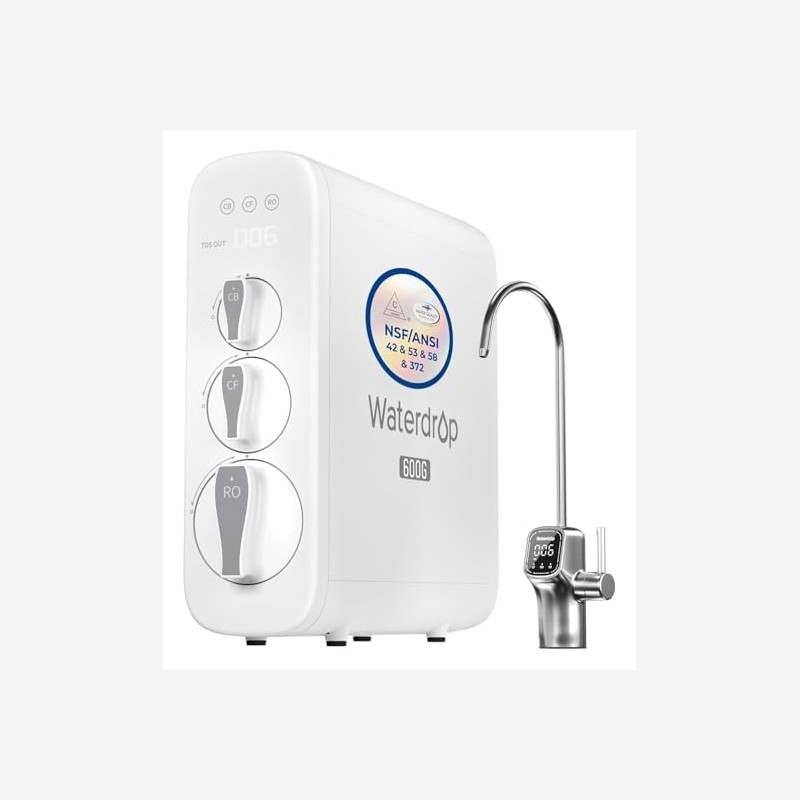
- Waterdrop G2P600 Under-Sink RO System, 600 GPD tankless — HPR 9.2, 1,739 reviews, $289 at the time of writing
- Waterdrop 10UA Under Sink Water Filter System, NSF/ANSI 42 — HPR 9, 14,186 reviews, $38 at the time of writing
Purchase price is not ownership cost. Run two calculations before you compare HPR numbers:
Annual consumable cost = cartridge price × replacements per year
Cost per liter = (system price + annual consumable cost) ÷ liters you actually draw per year
Get the maker's cartridge price and rated capacity, then do the arithmetic yourself. Note also that 600 GPD is a flow rate, not a cartridge life — it tells you how fast the faucet fills a glass, nothing about how often you'll be buying filters.
Two smaller things worth noticing. The $38 unit has 14,186 reviews against 5,250 and 1,739 for the RO units — review counts track price, not fluoride removal, so don't read popularity as performance. And tankless removes the storage tank from the cabinet; it doesn't remove the plumbing question. Confirm the drain connection and power supply for your specific model before ordering, because that's a fit issue a $38 inline cartridge never raises.
Why the old answer no longer applies
The older framing was "more stages, better water," and "any carbon filter cleans your water." Both were serviceable when the question was chlorine taste. Neither survives contact with a dissolved ion.
Two things shifted. First, fluoride removal turned out to be a media question, not a stage count. A five-stage carbon system with no RO membrane and no alumina does nothing to fluoride — you can add carbon stages all day and the ion passes through every one of them. Second, certification language got more specific in how people read it. A listing that names the contaminant is now the difference between a claim and a fact, and general taste-and-odour wording no longer gets read as covering everything in the tap.
The boiling advice aged worst of all. It never was a fluoride answer — it concentrates fluoride as water evaporates — but it sat in the same paragraph as "if you're worried about your water," which is how it got adopted. If you've been working from any of those three ideas, the checklist has changed: identify the contaminant, check the media, then check the listing.
Bottom line
If fluoride is the target, you need a reverse osmosis membrane or activated alumina. Carbon block and granular carbon are for chlorine, taste, odour, sediment and some organics, and extra carbon stages don't change that. Of the three units here, two are RO — HPR 9.4 at $429 with 5,250 reviews, and HPR 9.2 at $289 with 1,739 reviews — and the third is an NSF/ANSI 42 carbon unit at $38 with 14,186 reviews that is not a fluoride product and isn't pretending to be. RO also strips minerals, so price a remineraliser stage if that's a dealbreaker, and run cartridge price × replacements per year before you compare anything.
Next step: pull the certification listing for the exact model you're considering and search the document for the word fluoride. If the listing names it, keep going. If it names only taste and odour, you're buying a taste filter — which is fine, as long as that's what you meant to buy.
FAQ
Does a carbon block filter remove fluoride? No. Carbon block reduces chlorine, taste, odour, sediment and some organics. Fluoride is dissolved, and carbon has no mechanism to reject it, so it passes through whether the housing holds one stage or five.
Does boiling water remove fluoride? No — it concentrates it. Water evaporates and fluoride stays behind, so the concentration in the remaining water goes up rather than down.
What actually removes fluoride from drinking water? Two media: a reverse osmosis membrane, which rejects dissolved ions, and activated alumina, which removes fluoride but has a shorter service life than carbon. Boiling does neither.
Is an NSF/ANSI 42 listing enough for fluoride? No. Look for a certification listing that names the contaminant you're targeting. A general taste and odour claim says nothing about fluoride, and that includes the NSF/ANSI 42 listing on the Waterdrop 10UA.
Will a multi-stage under-sink filter remove fluoride? Stage count isn't a fluoride spec. Unless one of those stages is an RO membrane or activated alumina, the fluoride stays in the water.
```json { "@context": "https://schema.org", "@type": "FAQPage", "mainEntity": [ { "@type": "Question", "name": "Does a carbon block filter remove fluoride?", "acceptedAnswer": { "@type": "Answer", "text": "No. Carbon block reduces chlorine, taste, odour, sediment and some organics. Fluoride is dissolved, and carbon has no mechanism to reject it, so it passes through whether the housing holds one stage or five." } }, { "@type": "Question", "name": "Does boiling water remove fluoride?", "acceptedAnswer": { "@type": "Answer", "text": "No — it concentrates it. Water evaporates and fluoride stays behind, so the concentration in the remaining water goes up rather than down." } }, { "@type": "Question", "name": "What actually removes fluoride from drinking water?", "acceptedAnswer": { "@type": "Answer", "text": "Two media: a reverse osmosis membrane, which rejects dissolved ions, and activated alumina, which removes fluoride but has a shorter service life than carbon. Boiling does neither." } }, { "@type": "Question", "name": "Is an NSF/ANSI 42 listing enough for fluoride?", "acceptedAnswer": { "@type": "Answer", "text": "No. Look for a certification listing that names the contaminant you're targeting. A general taste and odour claim says nothing about fluoride, and that includes the NSF/ANSI 42 listing on the Waterdrop 10UA." } }, { "@type": "Question", "name": "Will a multi-stage under-sink filter remove fluoride?", "acceptedAnswer": { "@type": "Answer", "text": "Stage count isn't a fluoride spec. Unless one of those stages is an RO membrane or activated alumina, the fluoride stays in the water." } } ] } ```


