 Handpicked
Do Video Doorbells Need a Subscription?
The doorbell works without one. What you lose is recorded history, and that is the feature most people bought it for.
7 min read
Handpicked Reviews
Written and dated by our editors.
 By Owen BlakeOwen Blake · Video Doorbell EditorPublished in September 2026
Quick answerquickAnswer: No. Live view, two-way talk and motion alerts work with no subscription on nearly every model. What you pay for is cloud clip history — without it, most doorbells keep only a live view and whatever local storage holds. Whether that's enough depends on your door, not on your app. In this guide: - Do video doorbells need a subscription? - What stops working when you skip the cloud plan? - How do you get local storage instead of a plan? - Can you mix camera brands on one plan, and what does it cost per camera per year? - Why the old answer no longer applies - Bottom line
On this page
- Do video doorbells need a subscription?
- What stops working when you skip the cloud plan?
- How do you get local storage instead of a plan?
- Can you mix camera brands on one plan, and what does it cost per camera per year?
- Why the old answer no longer applies
- Bottom line
Do video doorbells need a subscription?
Stand at your front door before you answer this. The subscription question is a storage question in disguise, and storage depends on conditions outside the app: whether there's a wire in the frame, how strong your Wi-Fi is at the threshold, and whether anything in the box can hold a memory card.
On the software side it's short. Live view, two-way talk and motion alerts work with no subscription on nearly every model. Those three things are what most people use a doorbell for — seeing who's there, talking to them, getting the alert. Nobody charges for that anymore.
The paid part is cloud clip history. Without a plan, most doorbells keep only a live view and whatever local storage holds — and no local storage means no past. The package that arrived at 2pm and became a question at 6pm is the exact problem a plan solves and a live view doesn't.
Three things to measure before you buy anything
The transformer. A wired doorbell uses your existing doorbell power. Open the chime box, read the output printed on the transformer, and compare it with the doorbell's spec sheet before checkout — not after the bracket is on the wall. No transformer, no wire, and you're in battery territory, which changes the storage math.
Wi-Fi at the door itself. Not in the hallway, not from the couch. Stand where the doorbell will sit, close the door, and look at the signal. Then watch the round trip, because live view and two-way talk both travel through that connection: a doorbell on a weak signal is a conversation with a lag in the middle of it.
The frame and the old wire. Trim thickness decides whether the mounting plate and any angle wedge sit flat, and whether an old doorbell wire actually protrudes far enough to reach the terminals. On metal doors and thick trim, the camera angle you see in the product photos is not the angle you get.
What stops working when you skip the cloud plan?
Alerts, live view, two-way talk: unaffected. Clip history: gone unless something local is holding it.
The other thing that goes missing has nothing to do with the plan. Battery models need recharging, and they often cannot pre-record — the clip starts when the sensor wakes, so the seconds before the motion event are already lost. No subscription buys those seconds back. Pre-recording is a power and hardware question: wired doorbells draw from existing doorbell power instead of a battery you have to remember, and that's where you should spend your decision-making, not on plan tiers.
How do you get local storage instead of a plan?
Local storage means a chime or a hub with a memory card, and not every model supports one. That sentence should reshape your shopping list. You're not really choosing a doorbell; you're choosing the box it writes to.
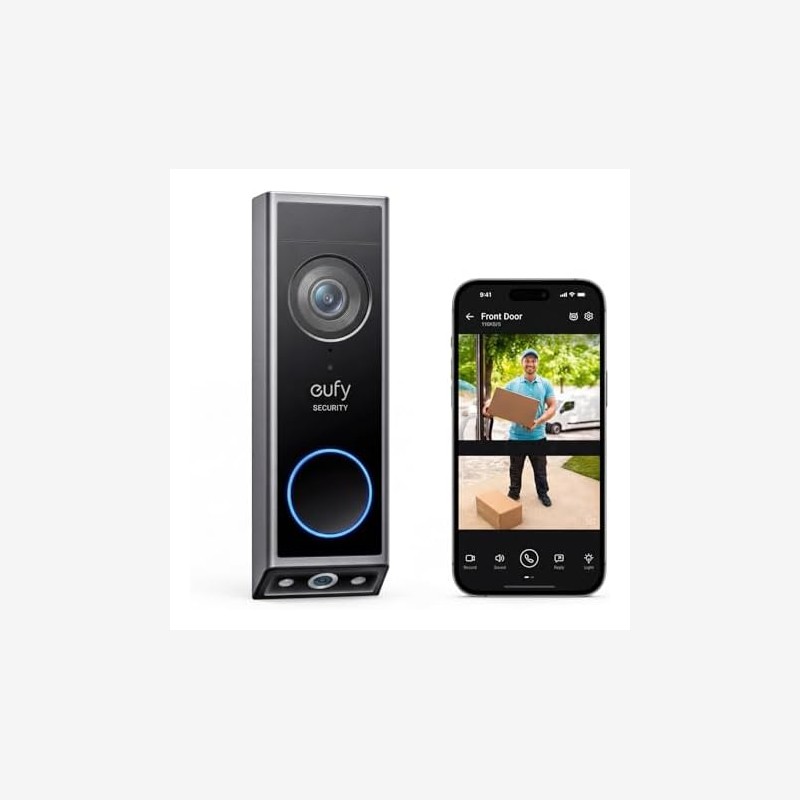
Look at how the E340 is sold. The doorbell-only listing is $150, rated HPR 9.4 across 4,424 reviews. The Kit with Chime is $180 (HPR 9.2, 704 reviews) and the Kit with Battery is $170 (HPR 9.0, 1,170 reviews) — the same 2K FHD doorbell with a different accessory in the box.
If the whole point is to skip a plan, the $180 chime kit is the version worth the $30 over the doorbell alone — but confirm the chime takes a memory card before you pay. Not every model supports local storage, and if this one doesn't, the extra $30 buys you a doorbell chime and nothing else, which puts you back on live view or back on a plan.
Worth knowing while you're comparing listings: the $150 E340 is the one stated as Dual Cameras, 2K FHD. The second camera looks down at the doorstep, which is where a package actually lands. A single lens at chest height catches a box only if it's been pushed back toward the wall; the downward lens is the difference between "someone was here" and "here's the box." If that downward view is your reason for choosing this doorbell, buy the listing that spells out Dual Cameras.
Can you mix camera brands on one plan, and what does it cost per camera per year?
Check what the plan costs per camera per year before you commit to an ecosystem, because cameras cannot be mixed freely. A doorbell from one brand and a floodlight cam from another means two apps, two subscriptions and two renewal dates.
Do the arithmetic on the whole house, not the door: a doorbell plus a driveway camera plus a backyard camera, priced per camera, per year, multiplied by the years you expect to keep the hardware. We're not printing a plan price here — tiers and regional pricing shift, and the number that matters is the one on the brand's page the day you buy. The camera is the part you keep; the plan is the part that keeps charging.
Why the old answer no longer applies
This question used to have a flat yes. That was correct when cloud storage was the only place footage could live and basic app functions sat behind a tier. Two things moved: live view, two-way talk and motion alerts became free on nearly every model, and local storage moved into chimes and hubs you buy once instead of rent monthly. The paid layer narrowed down to clip history.
What didn't move: per-camera-per-year pricing, the wall between ecosystems, and battery doorbells that may not pre-record no matter what you pay. And the honest limit of this update — the options with real numbers behind them are three E340 configurations: the $150 doorbell, the $180 chime kit, the $170 battery kit. Three is a small pool, and we'd rather name three with review counts attached than pad a list with doorbells we can't verify. Prices are the ones on the page at the time of writing, in USD.
Bottom line
You don't need a subscription for a live view, two-way talk or alerts. You need one if you want to scroll back through yesterday's footage and you don't have a chime or hub holding a card. On the numbers we have, the $150 E340 carries the strongest signal (HPR 9.4, 4,424 reviews), while the $180 chime kit is the version to buy if local storage is your substitute for a plan — subject to that card slot checking out. Next step, before you order anything: stand at the door with your phone and read the Wi-Fi, then open the chime box and read the transformer.
Do motion alerts work without a subscription?
Yes. Alerts, live view and two-way talk work with no subscription on nearly every model. The paid tier covers cloud clip history, not the alert itself.
Does the eufy E340 need a subscription?
Not for live view, two-way talk or alerts. Cloud clip history is the paid piece. If you want to avoid the plan entirely, verify that the chime or hub in the kit you're buying accepts a memory card, since not every model supports local storage.
Is local storage actually cheaper than a plan?
It's a one-time purchase — a chime or hub plus a card — against a recurring per-camera-per-year fee. The catch is support: not every model can do it, so it has to be confirmed before purchase, not after. A kit that can't take a card leaves you on a plan or on live view only.
Can a doorbell record before motion without a subscription?
Pre-recording is a power question, not a plan question. Battery models need recharging and often cannot pre-record, so the clip begins when the sensor wakes. Wired doorbells use existing doorbell power, which is why the transformer check comes before the plan comparison.


