 Handpicked
Does a Mini-Split Heat in Winter?
Most ductless systems are heat pumps and do heat, until the outside temperature drops. Here is the number that decides it.
9 min read
Handpicked Reviews
Written and dated by our editors.
 By Tobias RennerTobias Renner · HVAC & Heating EditorPublished in September 2026
Quick answerYes — a ductless mini-split is a heat pump, and it heats by reversing the refrigerant cycle. But capacity drops as outdoor air gets colder, so the real question isn't yes or no; it's whether the rated output at your winter design temperature covers your room load. Check that before you buy.
On this page
- What this article covers
- Does a mini-split heat in winter, or is that marketing?
- How do I know a unit will keep up with my coldest week?
- 115V or 230V — what circuit does a mini-split need?
- Why the old answer no longer applies
- What does SEER2 tell me about winter running cost?
- Which maintenance keeps heat output up?
- Bottom line
What this article covers
- Does a mini-split heat in winter, or is that marketing?
- How do I know a unit will keep up with my coldest week?
- 115V or 230V — what circuit does a mini-split need?
- Why the old answer no longer applies
- What does SEER2 tell me about winter running cost?
- Which maintenance keeps heat output up?
Does a mini-split heat in winter, or is that marketing?
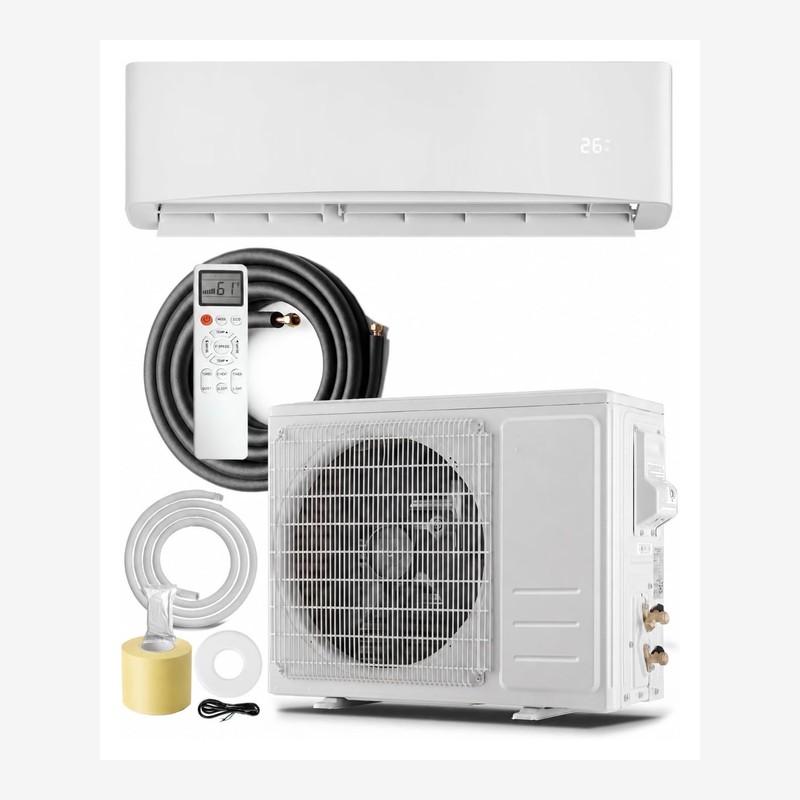
It heats. A ductless mini-split is a heat pump: it reverses the refrigerant cycle, so the outdoor coil becomes the evaporator and the indoor head becomes the condenser. Nothing about that is decorative, and there is no separate "heating element" doing the work in the units we track.
The catch is capacity, not capability. Heating output falls as outdoor temperature drops, because there is less heat to move from colder air and because the unit spends time in defrost. So the useful question isn't "does it heat?" — it's "does it still produce the BTU my room needs on the coldest night of my year?"
That means two numbers have to line up: the load of the room, and the unit's rated output at your winter design temperature. Manufacturers publish heating capacity across a range of outdoor temperatures. Read the row that matches your climate, not the headline number on the box.
Two units we currently have data on, so you can see the shape of the market:
| Model | Nominal capacity | Electrical | Our HPR score | Reviews | Price at writing | |---|---|---|---|---|---| | DELLA Vario | 12,000 BTU | 115V | 9.3 | 1,444 | $780 | | DELLA Motto | 9,100 BTU, 20.5 SEER2 | 115V band | 9.1 | 835 | $650 |
HPR is our own comparison score, not a manufacturer spec — it weighs what the spec sheet and the review history show, not a lab test we ran. We don't run a lab.
How do I know a unit will keep up with my coldest week?
Start with the room, not the brand. Sketch the space, note which way the glass faces, count the windows, and note what sits above and below it. A west-facing room with a lot of glass and an unconditioned space under it is a different load from an interior bedroom of the same floor area, and it will need more output.
Then size for the heating case, not only the cooling case. In cold climates, the heating load is usually the one that decides capacity. But don't simply buy the biggest head that fits the wall, because oversizing creates its own problems:
- Short cycling. An oversized head hits setpoint fast, shuts off, then restarts. You get wider temperature swings and more start-stop wear.
- Weak summer dehumidification. In cooling mode, an oversized unit cools the air before it has time to wring moisture out of it. The room feels clammy at a temperature that should feel fine.
- A louder, draftier room. Bigger heads move more air to do the same job.
Nominal BTU is the beginning of the conversation, not the whole of it. The 9,100 BTU DELLA Motto is a sensible pick for a single closed bedroom; put it in an open-plan living space with a stairwell and it will run near continuously and still lose ground. The 12,000 BTU DELLA Vario covers more room, but see the circuit note below.
115V or 230V — what circuit does a mini-split need?
The 9,000–12,000 BTU class usually runs on a dedicated 115V circuit. Larger sizes need 230V. "Dedicated" is the operative word: this is not a circuit you share with a bathroom fan and a space heater.
Both units in our table sit in that 115V band, including the 12,000 BTU Vario — which puts it at the top of the range that 115V comfortably serves. If you are planning a second head, a larger head, or a multi-zone setup, plan for 230V.
Two installation rules I will not bend on:
- Do not pull the high-voltage circuit yourself. Terminating a mini-split's power feed is electrician work. Get a permit where your jurisdiction requires one, and get a disconnect where code calls for it.
- The refrigerant side is licensed work too. Line sets must be pressure-tested and evacuated with a vacuum pump before charging, and the charge weighed in per the manufacturer's length table. Skip the evacuation and you leave moisture and air in the system — that shows up months later as poor heating and a compressor you have to replace.
Also plan the condensate path now. In heating mode the outdoor unit produces defrost water, and the indoor drain has to run downhill to somewhere that will not freeze.
Why the old answer no longer applies
The old answer was written for a different generation of equipment and a different rating system. It came in two flavors: "heat pumps are for mild climates," and "just match the tonnage." Both were shortcuts around the two things that actually decide winter performance — rated output at your design temperature, and the electrical and drainage conditions at your wall.
What changed:
- Efficiency labels changed shape. Seasonal ratings now describe performance across a season rather than one operating point, so a single number on a spec sheet tells you less about a cold night than it used to.
- Capacity data got more granular. You can now read heating output at several outdoor temperatures instead of guessing from the nominal BTU figure.
- The 115V band got busier. More of the 9,000–12,000 BTU class runs on 115V, which makes circuit planning the bottleneck more often than equipment availability.
- Review history became readable. The Vario carries 1,444 reviews and the Motto 835 — enough volume that patterns like drain noise or filter complaints show up rather than sitting in a single outlier.
The practical update: the answer is no longer a brand verdict. It's a load number, a circuit, and a drainage path.
What does SEER2 tell me about winter running cost?
Less than people assume. SEER2 is a cooling-season efficiency rating. It tells you how efficiently the unit removes heat in summer, and it is a reasonable way to compare two units for cooling cost. It says nothing about how many BTU of heat the unit produces at your outdoor design temperature.
The Motto's 20.5 SEER2 is a strong cooling number for a 9,100 BTU head. It does not tell you the unit will hold a bedroom at setpoint at your coldest outdoor temperature — that comes from the heating capacity table.
So for winter, compare heating output at design temperature, and then compare how the unit behaves when it can't keep up. Short cycling in shoulder season wastes energy in a way no rating captures, and a head that is oversized for the room will cycle regardless of its seasonal score.
Which maintenance keeps heat output up?
Filters first. Clean them every two to four weeks in season. A clogged filter is the usual cause of poor output — the unit is fine, the airflow is not, and the symptom looks like a capacity problem. If your heat feels weak in February, check the filter before you call anyone.
Then the once-a-year items:
- Indoor head: clean the blower wheel and check the drain pan and line for slime and standing water.
- Outdoor unit: clear leaves and snow from the coil, and keep the defrost drain path open.
- Service access: leave clearance around both units, including above the indoor head. A head installed tight into a corner costs you money at every service visit.
- Refrigerant: a system that needs topping up has a leak. Find it, don't just refill it.
Bottom line
A mini-split will heat in winter — it is a heat pump, and reversing the cycle is the whole point. Whether it keeps your rooms warm is a load-and-circuit question: match rated heating output at your winter design temperature to the room, keep the head inside the 115V or 230V band your panel can actually feed, and clean the filter every two to four weeks in season. The DELLA Vario (12,000 BTU, HPR 9.3, 1,444 reviews, $780 at writing, 115V) sits at the top of the 115V class; the DELLA Motto (9,100 BTU, 20.5 SEER2, HPR 9.1, 835 reviews, $650 at writing) is a small-room unit, and treating it as anything more is where buyers get disappointed. Our next step for you: measure the room, write down the window orientation, then check your panel for a spare dedicated circuit before you compare another spec sheet. Prices move, and so does stock — confirm both at checkout.
FAQ
Can a mini-split heat a whole house in winter? Per-room, usually. Each head is sized to its room's load, and multi-zone or larger single heads move you out of the 115V band and into 230V. There is no single answer without a load calculation per room.
Do mini-splits stop working below freezing? They keep running; they lose capacity. That is why you check rated output at your winter design temperature rather than trusting the nominal BTU number on the box.
Is 12,000 BTU enough for a bedroom? Depends on the room. The DELLA Vario is a 12,000 BTU, 115V unit with 1,444 reviews and an HPR of 9.3, priced at $780 when we wrote this — but a well-insulated interior bedroom and a glass-heavy corner room are not the same load at the same square footage.
Will a mini-split lower my heating bill? That depends on what you heat with now and what you pay for it, and we don't have those numbers for your house. What we can tell you: an oversized head short cycles, and cycling costs you regardless of the unit's efficiency rating.
How often should I clean the filter? Every two to four weeks in season. A clogged filter is the usual cause of weak heat output, and it is the cheapest thing on this list to rule out.


