 Handpicked
How Accurate Are Golf Rangefinders?
To the flag, within a yard or two. To the pin you actually want, it depends on what the beam hits.
7 min read
Handpicked Reviews
Written and dated by our editors.
 By Peter LindqvistPeter Lindqvist · Golf Gear EditorPublished in September 2026
Quick answerA laser rangefinder is accurate to about a yard at normal golf distances when it locks onto the flag. The number is rarely the problem — the miss is. Fog, backlight and a crowded treeline make it grab the group behind, and the slope mode that fixes your read is not legal for handicap rounds.
On this page
- In this piece
- How accurate is a golf rangefinder on an actual hole?
- Why does my rangefinder lock onto the wrong thing?
- Can you switch slope off, and does your card allow it?
- Does 7X magnification make a rangefinder more accurate?
- Why the old answer no longer applies
- The bottom line
In this piece
- How accurate is a golf rangefinder on an actual hole?
- Why does my rangefinder lock onto the wrong thing?
- Can you switch slope off, and does your card allow it?
- Does 7X magnification make a rangefinder more accurate?
- Why the old answer no longer applies
- The bottom line
How accurate is a golf rangefinder on an actual hole?
7:42 a.m., fog sitting low off the left side, par 3 with the pin back-left behind a maple. You shoot it, get 168, hit a smooth 7, and fly the green by eight yards. The rangefinder wasn't wrong. It measured the maple.
That's the whole story of rangefinder accuracy in one shot. Laser rangefinders are accurate to about a yard at normal golf distances when they lock onto the flag. Once you accept that number as the ceiling, the question changes from "how accurate is this thing" to "what did it just measure." Every complaint I hear on the first tee is the second question wearing the first question's clothes.
Why does my rangefinder lock onto the wrong thing?
The common failure is picking up a tree or the group behind instead of the pin. That's not a defect — it's the physics of a narrow laser looking for the strongest return, and it's exactly the problem that slope and pin-seeking modes exist to fix. Pin-seeking narrows what the unit accepts as a target. Slope does something different: it adjusts the distance for elevation change after the fact.
Keep those two separate in your head when you're shopping. One helps the unit find the flag. The other changes the number you're handed once it has. A unit that's good at the first and has an honest switch for the second is worth more than one that advertises 1500 yards on the box.
Can you switch slope off, and does your card allow it?
Slope mode adjusts the distance for elevation change. Under the rules of golf it is not legal for handicap rounds. That makes the switch — not the range, not the magnification — the spec that decides whether a unit goes in your bag on Saturday or stays in the car.
Three models cleared our bar this month. HPR is our score, built from review volume and buyer ratings; we don't run lab tests and neither does anyone else at this price.
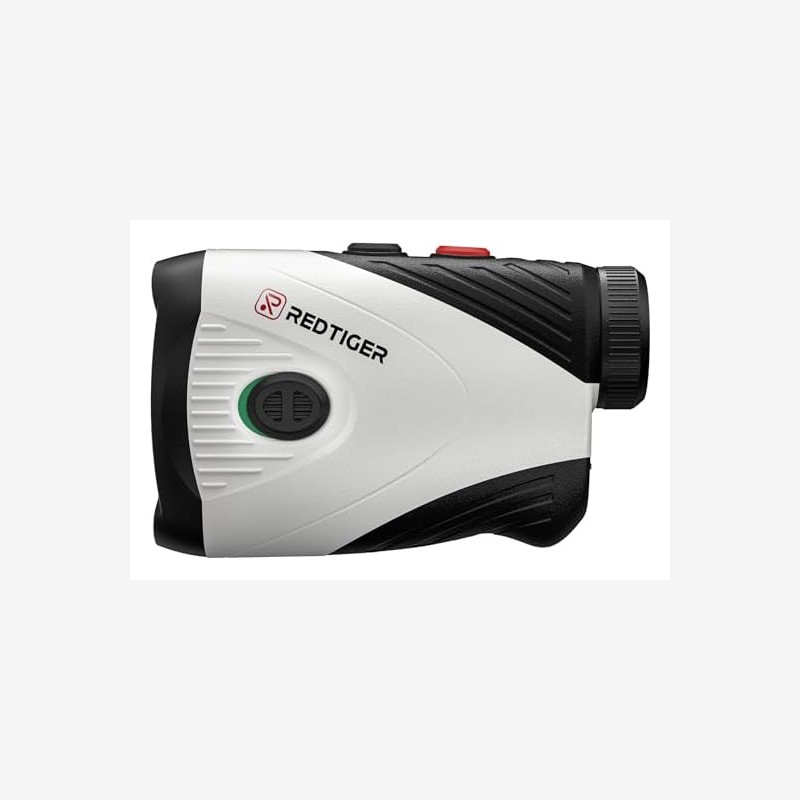
REDTIGER Golf Rangefinder with Slope On/Off, 7X Magnification — HPR 9.2, 5,830 reviews, $110 at writing. The on/off is in the product name, which tells you the company knows who buys it. Course condition: a handicap card on a course with a long uphill par 3, where every instinct says leave slope on. You switch it off on the first tee and it's a legal number all day.
REDTIGER Golf Range Finder, 7X Magnification 1200 Yards with Slope — HPR 9, 988 reviews, $110 at writing. Same price, a fifth of the review base, and the listing doesn't put the slope switch where you'd trip over it. Course condition: you play casual rounds, want the elevation read, and don't care about cards. If you do play cards, read that listing twice before checkout — $110 buys the same money either way, but only one of these two tells you up front what you're getting.
WOSPORTS Golf Rangefinder with Slope – 1200/1500 Yards — HPR 8.5, 285 reviews, $60 at writing. The cheapest of the three by a wide margin, and the one I'd hand a player who wants a distance on practice rounds and range sessions where legality is irrelevant. The name declares slope, not a switch. If anything you play counts, confirm the slope can be turned off before you buy, because that single detail is what retires rangefinders early — not wear, not battery.
That's the full list. Only three models cleared our threshold this month, and we'd rather show you three than pad it to ten.
Does 7X magnification make a rangefinder more accurate?
No. Magnification is a finder, not a measuring instrument. Two of the three above are 7X and the third doesn't declare it, but 7X doesn't tighten the laser. What it does is help you pick the flag out of a treeline at dusk and confirm you're aimed at the pin and not the cart behind it. Treat it as clarity, not precision. Your accuracy figure stays at about a yard, and only when the unit locked the flag.
Low light is where optics actually earn their keep. Backlit pin, dark trees behind it, 7 p.m. in October — that's the hardest target you'll face, and a cleaner image is what stops you from shooting the maple. A GPS watch will not help you there, because GPS watches and apps give front, middle and back of green rather than a single number, and their accuracy depends on the map data. In fog with no flag detail visible, that green depth is the safer read. On a clear morning with the pin tucked behind a bunker lip, the laser wins, because the map has no idea where the hole is cut.
Battery and carry, since it's the one spec people worry about for no reason: battery life on these is measured in thousands of measurements, and a CR2 cell usually outlasts a season. Throw one spare CR2 in the bag's front pocket and stop thinking about it.
Why the old answer no longer applies
The old advice was to buy the longest range you could afford. Longer is better, 1500 beats 1200, and so on. Two of the three units above list 1200 and 1500-yard capability, and none of it matters, because you will never shoot a flag from 1200 yards. You'll shoot it from 90 to 220. What decides whether a rangefinder works on your Saturday is whether it locks the pin at 150 yards in poor light and whether slope can be physically switched out of the way. Range figures sell units. Lock and legality are what you actually play with.
The second thing that changed is the shelf itself. This category used to be a wall of near-identical listings at near-identical prices. It still is — most of them just don't clear our review-count and score threshold. This month, three did, and the cheapest of them costs $60.
The bottom line
Accuracy isn't the weak link. It's about a yard at normal golf distances when the unit locks the flag, and the miss is almost always the lock. Buy for the switch: slope adjusts for elevation change and is not legal for handicap rounds, so if you play cards, that's the spec that outranks range and magnification. If you never play a counting round, the $60 WOSPORTS is the value pick. If you do, the $110 REDTIGER with Slope On/Off is the one that comes out of the bag on the first tee.
Next step: decide whether slope has to be switchable for the rounds you play, then pick from the three above. That one decision settles the rest.
FAQ
Are golf rangefinders accurate enough for tournament play?
The measurement is — about a yard at normal golf distances when locked on the flag. The risk is the mode. Slope adjusts the distance for elevation change and is not legal for handicap rounds, so the unit has to be able to run with slope off.
Do I need slope mode if I only play casual rounds?
It hands you an adjusted number for elevation change, which is genuinely useful on uphill and downhill approaches. If you also play counting rounds, treat slope as a practice-only feature and buy a unit you can switch out of it.
Is a GPS watch more accurate than a laser rangefinder?
They answer different questions. GPS gives front, middle and back of green, and its accuracy depends on the map data. A laser gives one number to whatever it locked onto — usually the pin, occasionally the maple.
How long does a rangefinder battery last?
Battery life is measured in thousands of measurements. A CR2 cell usually outlasts a season, so carry a spare and stop planning around it.
Does higher magnification make the distance reading more accurate?
No. Magnification helps you find and confirm the flag, especially in low light and backlight. It doesn't change accuracy, which stays at about a yard when the unit locks the flag.


