 Handpicked
How Long Do Wireless Earbuds Actually Last?
Battery life on the box assumes half volume with ANC off. Here is what changes the number, and when the cells stop holding a charge.
8 min read
Handpicked Reviews
Written and dated by our editors.
 By Aisha BelloAisha Bello · Audio EditorPublished in September 2026
Quick answerQuick answer: Quoted playtime is measured at about half volume with noise cancelling off, so your commute number is lower. The case adds two to four full recharges. Expect two to three years of daily use before runtime drops noticeably — and since earbud cells aren't user replaceable, battery life is a lifespan decision, not just a daily one.
On this page
- In this piece
- How many hours do wireless earbuds actually last on a charge?
- Does noise cancelling cost battery life?
- How much extra time does the charging case add?
- How long before the battery dies for good?
- Why the old answer no longer applies
- Bottom Line
In this piece
- How many hours do wireless earbuds actually last on a charge?
- Does noise cancelling cost battery life?
- How much extra time does the charging case add?
- How long before the battery dies for good?
- Which earbuds hold up in a commute or a workout?
- Why the old answer no longer applies
How many hours do wireless earbuds actually last on a charge?
Picture the 7:40 train: doors close, you tap a bud in, ANC on, volume up two notches because the carriage is loud. Every part of that sentence eats into the number printed on the spec sheet.
Quoted playtime is measured at about half volume with noise cancelling off. That's a lab-style condition, not a train. On a commute with ANC running and volume pushed up to cover engine noise, you should treat the quoted figure as a ceiling rather than a promise. In a quiet room at moderate volume you'll land closer to it; on a plane, or on a platform with an idling diesel, you won't.
This is the part most buyers get wrong: they compare two models by the headline hour count, then discover in week one that the loud-environment number is a different number entirely.
Does noise cancelling cost battery life?
Yes — ANC typically costs a meaningful share of the quoted playtime. That's the honest tradeoff behind the feature: the microphones and the processing that make a train carriage bearable are drawing from the same small cell that plays your audio.
But ANC isn't always the biggest drain. On some models, codec choice and volume matter more than noise cancelling does. And multipoint — staying connected to your laptop and your phone at the same time, which is exactly what an open office pushes you toward — costs a little in both buds.
In an open office, that stacks. You're running ANC against chatter, running multipoint across two devices, and probably streaming a higher-bitrate codec on the laptop. If your runtime disappoints you at your desk, that combination is the reason, not a defective battery.
How much extra time does the charging case add?
The case adds two to four full recharges, so your total listening time is case capacity multiplied by earbud capacity. That multiplication is the whole story, and it's why two earbuds with identical single-charge runtime can end a week in completely different places.
Do the arithmetic with your own ANC-on number, not the box number: if you get roughly two hours of real ANC listening per charge and the case gives you two recharges, you have about six hours of commute-grade audio before you're hunting for a cable. If you get closer to four hours per charge with a four-recharge case, you're at sixteen. Same category, very different week.
For heavy users — two commutes a day plus a workout — the low end of that two-to-four range is the one that matters, and it rarely shows up in the headline spec.
How long before the battery dies for good?
Lithium cells in earbuds are small, and they lose capacity faster than phone batteries do. Two to three years of daily use is normal before runtime drops noticeably — noticeably meaning you start leaving the case at home in a different way, or start charging mid-afternoon.
Earbud batteries are usually not user replaceable. That single fact reframes the purchase: you're not buying a daily runtime, you're buying a lifespan. A $53 pair that gives you two to three good years costs you roughly $18 to $27 a year; a $70 pair over the same window costs $23 to $35. Neither is a bad deal. Both are worse than the sticker price suggests, because you'll replace the whole product, not the cell.
Which earbuds hold up in a commute or a workout?
Three models made the shortlist we could verify this month — and only two of them are true earbuds. That's the honest size of the pool, not a rounding error.
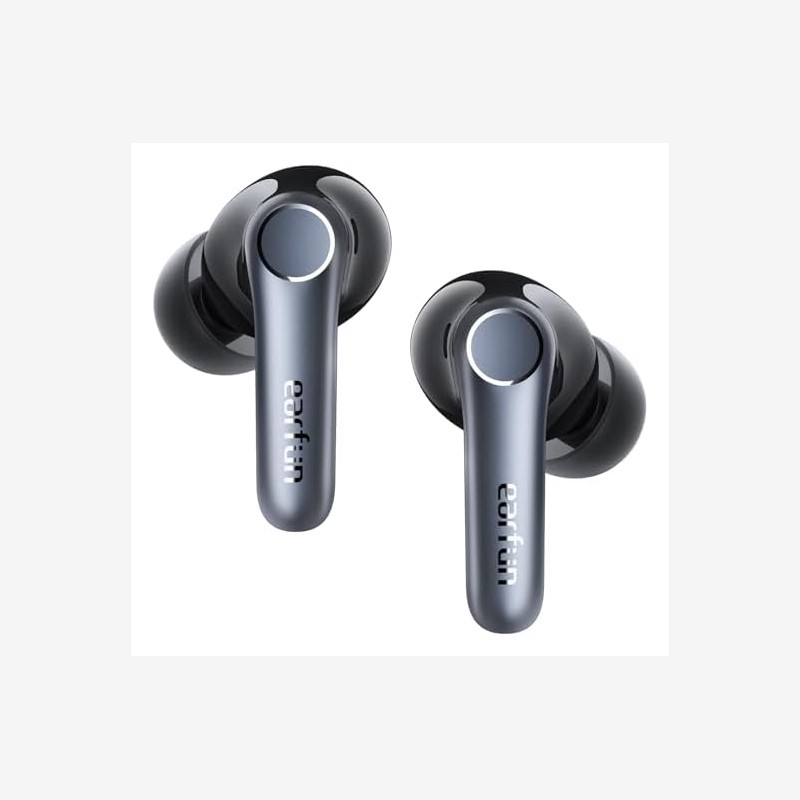
EarFun Air Pro 4 Adaptive Hybrid Noise Canceling Wireless Earb — HPR 9.4, 7,043 reviews, $53 at the time of writing. The cheapest of the three, which matters most once you accept the two-to-three-year window. Hybrid ANC depends on tip seal, so budget for trying a different tip size than the one in the box; a leaky seal gives you the battery cost of ANC with little of the quiet.
Soundcore Sport X20 by Anker Noise Cancelling Workout Earbuds — HPR 9.1, 15,963 reviews, $70 at the time of writing. For running and gym work, seal stability beats the ANC figure: sweat and motion break the seal, and a bud that shifts mid-treadmill costs you bass and call clarity at the same time. Fit is the spec here, not the driver.
Soundcore by Anker Q30 Hybrid Active Noise Cancelling Headphon — HPR 9, 97,290 reviews, $56 at the time of writing. This is an over-ear headphone, not an earbud, and that's the point: it sidesteps the tip-seal problem entirely. If every tip you've tried leaks, this is the structural fix. The case-recharge arithmetic above doesn't apply to it.
Why the old answer no longer applies
Older buying guides told you to compare quoted playtime and pick the bigger number. That advice assumed the quoted number was the number you'd live with, and assumed battery was a daily spec rather than a product lifespan.
Both assumptions broke. Quoted playtime is measured at about half volume with ANC off, so it doesn't describe a commute, a flight, or a loud office — the environments where you actually want earbuds. Multipoint has become standard, and it costs a little in both buds. And on some models, codec and volume drain more than ANC does, which flips the usual "turn off ANC to save battery" instinct.
The bigger shift is time. Once you know earbud cells aren't user replaceable and that two to three years of daily use is the normal window before runtime drops, the spec that matters isn't hours per charge — it's hours per charge multiplied by case recharges, divided by how long the cell survives. Nobody printed that number on the box in 2019, and most listings still don't.
Bottom Line
Your real runtime is the ANC-on number at your typical volume, not the spec sheet, and the case gives you two to four of those on top. Small cells in earbuds degrade faster than phone batteries, and since they're not user replaceable, two to three years of daily use is the realistic life of the product. That makes cheap-and-good a defensible strategy: the $53 EarFun Air Pro 4 (HPR 9.4) risks less over its lifespan than a pricier pair with the same window. If seal is the problem rather than battery, the $56 Soundcore Q30 removes tips from the equation entirely.
Next step: measure one thing this week. Note how long your current buds last on a charge with ANC on, at the volume you actually use, then multiply by your case's recharge count. That product — not the box — is what you're shopping for.
FAQ
Is quoted earbud battery life a lie?
No. It's a measurement condition: about half volume, noise cancelling off. The problem is that almost nobody listens that way outdoors, so treat the quoted figure as an upper bound and expect less anywhere you're raising volume to compensate for noise.
Should I pick earbuds by bud battery or case battery?
Both, because they multiply. Total listening time is case capacity times earbud capacity, and the case adds two to four full recharges. A modest bud with a generous case can outlast a bigger bud with a thin case across a week of commuting.
Can I replace the battery when it wears out?
Usually not — earbud batteries are typically not user replaceable. Two to three years of daily use is normal before runtime drops noticeably, so plan on replacing the product, and factor that into what you're willing to spend.
Does turning off ANC always buy me more hours?
Not always. ANC typically costs a meaningful share of quoted playtime, but on some models codec choice and volume matter more, and multipoint costs a little in both buds. If you need hours back, try dropping volume or disabling a second connection first.
Do over-ear headphones solve the fit problem?
Structurally, yes — they don't depend on ear tip seal, so they don't lose bass and noise reduction when a tip leaks. They're a different product class, though: the charging-case arithmetic and the two-to-three-year earbud cell window don't carry over directly.


