 Handpicked
How Long Should a Massage Gun Session Be?
Two minutes per muscle group, not twenty. Amplitude matters more than speed, and some places you should not press at all.
7 min read
Handpicked Reviews
Written and dated by our editors.
 By Tessa BrandtTessa Brandt · Recovery & Massage EditorPublished in September 2026
Quick answer`quickAnswer` — Two minutes per muscle group, one pass, is the working answer. Use the lowest speed that still moves tissue, keep the head on muscle belly, and stay off the spine, joints, and any recent injury. Amplitude and stall force decide more about your result than percussions per minute.
On this page
- How long should a massage gun session be?
- Is two minutes per muscle group the ceiling?
- Amplitude or percussions per minute — which one are you buying?
- What does stall force tell you about your hand pressure?
- Where should you never point a massage gun?
- Why the old answer no longer applies
- Bottom line
How long should a massage gun session be?
Name the part and the job before you name a number. A calf that's tight after a long run, a stubborn spot under the shoulder blade, a glute you want awake before a heavy set — those are three different jobs, and only one of them is really release.
For all three, the number is the same: two minutes per muscle group, one pass. That's the usual recommendation, and it applies whether the group is small or large. Longer is not better.
The short window is deliberate. A percussion head keeps firing at the same tissue whether or not that tissue is still responding, so time on the clock isn't the same as input delivered. Past the first pass, you're mostly repeating something the muscle has already received.
Is two minutes per muscle group the ceiling?
Yes — and it's per group, not per session. Four groups is four two-minute passes, not eight minutes on the spot that bothers you most.
The most common mistake is treating "still feels tight" as a reason to add minutes. If two minutes didn't change the sensation, another two usually won't either. Move to the tissue around the area, or stop and come back to it later. The spot that never changes under percussion is information about the spot, not a challenge for the motor.
Amplitude or percussions per minute — which one are you buying?
Amplitude (stroke depth) matters more than percussions per minute. That ordering is the part most spec sheets get backwards, because percussions per minute is the bigger, louder number printed on the box.
Think about what each one describes. Percussions per minute tells you how fast the head taps the surface. Amplitude tells you how far the head travels, which is what determines whether the input reaches past the top layer of tissue instead of buzzing on it. A fast head with a shallow stroke feels busy and accomplishes very little. If you're comparing two guns and only one number survives the comparison, keep amplitude.
What does stall force tell you about your hand pressure?
Stall force is how much pressure the motor holds before it stops. There are two reasons to care, and the second one is the reason this matters for how you actually use the thing.
First, it tells you what the device can absorb when you lean into it. Second, it tells you when you have become the mechanism. If your body weight can stall the motor, you're no longer getting percussion — you're pressing a dead motor into your own leg. The tool is supposed to deliver the force. You deliver the position.
Two units in our data this month bracket the range:
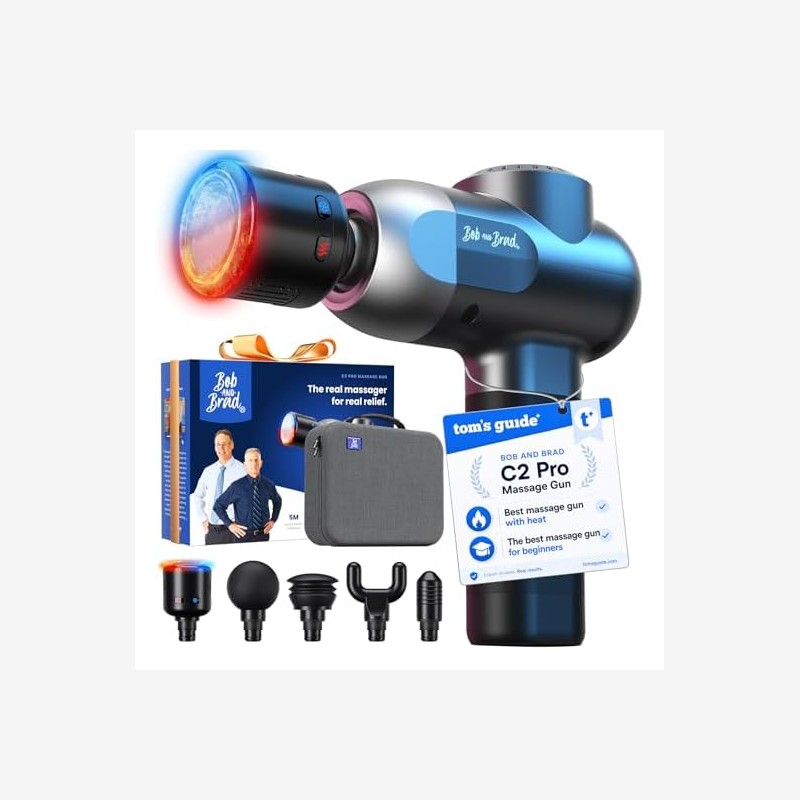
| Model | HPR | Reviews | Price (at writing) | |---|---|---|---| | BOB AND BRAD Q2 Pro Mini with Heat | 9.4 | 15,453 | $90 | | BOB AND BRAD D6 Pro Plus | 9.3 | 1,404 | $206 |
The HPR gap is 0.1. The price gap is $116. Scores that close don't separate these two, so the review base does the deciding — 15,453 reports versus 1,404 is a different amount of evidence, not a different amount of quality. Only two models cleared our threshold this month, and we'd rather show you two than pad a list.
Where should you never point a massage gun?
Spine, joints, and recent injuries. That's the whole list, and it doesn't shrink for smaller heads or lower speeds.
Two more boundaries that follow from the same idea:
- It's a recovery tool, not a treatment. Percussion doesn't diagnose, repair, or resolve anything structural.
- Pain is not a target. If the sensation gets sharper as you press, back off. The instinct to "work through" a sore spot is exactly the instinct this tool punishes.
My stop line, as a person who writes about recovery gear rather than practicing on you: stop if the area feels worse after a pass, if the feeling turns sharp rather than dull, or if you're reaching for a higher speed to recreate what a lower speed gave you last time. And if something is numb, weak, or swollen, or it hasn't changed with rest and normal movement, that's a conversation with a clinician — not a setting on the gun.
Why the old answer no longer applies
The guidance that circulated a few years back had two halves: buy the biggest percussions-per-minute figure you can afford, and keep the gun on a spot until it "releases." Both halves fail the same way — they assume more input produces more result.
The spec hierarchy has since flipped. Amplitude is the comparison that predicts whether the head reaches tissue, and percussions per minute is the one that mostly measures how the box looks. The product landscape shifted with it: minis and mid-size units now sit at the top of the scores rather than the bottom, so the buying question moved from "how fast" to "how deep, and how much evidence sits behind it."
"Until it releases" also lost its footing because it has no endpoint. Two minutes per muscle group has one. You can set it, finish it, and judge the result at the timer instead of guessing at a feeling.
Bottom line
Two minutes per muscle group, one pass, lowest speed that still moves tissue. Buy on amplitude and stall force; percussions per minute is the number that sells, not the number that works. Keep the head off the spine, joints, and anything recent. This month, the two models in our data that cleared the bar sit $116 apart — BOB AND BRAD Q2 Pro Mini with Heat at $90 (HPR 9.4, 15,453 reviews) and BOB AND BRAD D6 Pro Plus at $206 (HPR 9.3, 1,404 reviews) — with HPR scores 0.1 apart, so the real difference is price and how much reviewer evidence you get.
Next action: pick the one area bothering you, set two minutes, and make the call when the timer ends. No change means a different approach or a different person, not more minutes.
FAQ
How long should a massage gun session be per muscle?
Two minutes per muscle group, one pass. That's the usual recommendation regardless of muscle size, and extending it is not better.
Is it OK to use a massage gun for 10 minutes on one spot?
The recommendation is short by design, and it's per muscle group rather than per session. A long single pass on one spot is the most common way people turn a recovery tool into an irritant without noticing the switch.
What matters more, amplitude or percussions per minute?
Amplitude — stroke depth. Percussions per minute is the larger number on the packaging; amplitude determines whether the head travels far enough to reach past the surface layer.
What is stall force, and should I push until the gun stalls?
Stall force is how much pressure the motor holds before it stops. You don't need to reach it. If you're leaning hard enough to stall the motor, the force is coming from you rather than the device.
Can I use a massage gun on my spine, a joint, or a recent injury?
No. Spine, joints, and recent injuries stay off the list. This is a recovery tool, not a treatment, and a sore spot does not improve by adding load to it.


