 Handpicked
What Size Power Bank Can You Take on a Plane?
The limit is watt-hours, not milliamp-hours, and the airline reads the label on the case. Here is how to check before you fly.
9 min read
Handpicked Reviews
Written and dated by our editors.
 By Diego SalasDiego Salas · Charging & Power Banks EditorPublished in September 2026
Quick answerMost airlines let you carry a power bank up to 100 Wh in the cabin with no approval, 100–160 Wh only with airline approval, and nothing above 160 Wh at all. A 20,000 mAh cell at 3.7 V works out to about 74 Wh. What gets checked is the printed Wh marking on the case, not the mAh on the box.
On this page
- How many watt-hours can you take on a plane?
- How do I turn mAh into Wh before I buy?
- What does the airline actually read on the case?
- Which travel power banks fit these limits?
- Why the old answer no longer applies
- Bottom line
How many watt-hours can you take on a plane?
Before size, I ask a different question: what are you charging, and at how many watts? A phone and a 16-inch laptop are not the same purchase, and neither of them changes the aviation rule, which is written in watt-hours:
- Up to 100 Wh: carry-on, no approval required.
- 100–160 Wh: carry-on only, and only with airline approval.
- Above 160 Wh: not allowed in the carry-on.
- Spare lithium batteries: never allowed in checked baggage.
Two failure modes show up constantly. The first is a bad conversion — someone assumes a big mAh number is automatically legal, or that a small one is automatically fine. The second is packing the bank in the bag you hand over at the counter. Above 160 Wh is disallowed in the cabin, and a spare battery is disallowed in the hold regardless of its rating, so the Wh figure stops mattering the moment the bag is checked.
How do I turn mAh into Wh before I buy?
Watt-hours equals amp-hours times volts. A 20,000 mAh cell at 3.7 V is about 74 Wh. That is the number that matters, and 74 Wh sits under the 100 Wh line — provided the case carries a legible marking.
The mAh figure on the box is a cell rating taken at cell voltage. It is not a promise of what leaves the USB-C port, and it is not a count of how many times your phone gets filled.
Cell rating vs. 5 V output
Capacity measured at 5 V output is not the same as the cell rating, and marketing tends to quote whichever number looks bigger. Conversion losses are real, so treat the cell rating as the rough size of the tank and the Wh figure as the legal one. If you are comparing two banks and only one prints its Wh, buy that one. Provided the printed rating is there and legible.
What does the airline actually read on the case?
The printed rating. Airlines read the printed rating on the case, and a bank with no visible Wh marking can be refused even if it is small. This is the part people argue with me about, and it is the part that costs them the bank at the gate.
Practical version: before you fly, find the Wh stamp on the shell. If it is rubbed off, or printed only as mAh with no voltage, you are asking an agent to do math on your behalf. Keep spare banks in their own pouch with the terminals taped, keep them in the cabin bag, and keep them out of the seat-back pocket where the tray table crushes them.
Which travel power banks fit these limits?
Only three models cleared the bar this month, and I would rather list three than pad the list with seven. Two of them are laptop-class banks at 24,000–25,000 mAh, which is exactly where the 100 Wh conversation gets uncomfortable: the larger the cell, the closer you sit to a line an agent can read straight off the label.
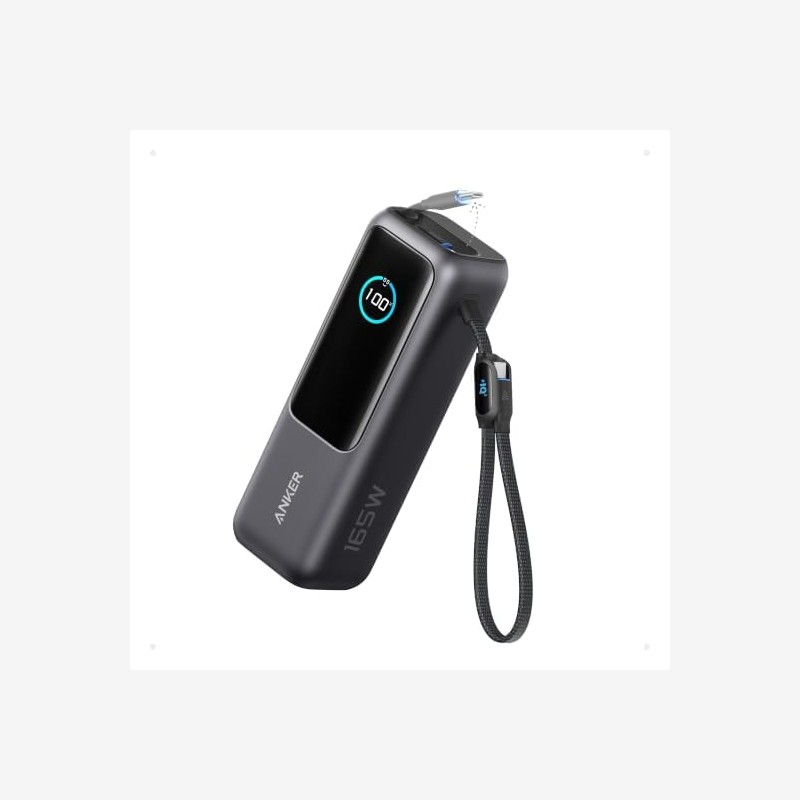
- Anker Laptop Power Bank, 25,000mAh Travel Essential with 165W — HPR 9.5, 12,148 reviews, $105 as of writing. The highest-rated of the three and the cheapest of the two big ones, which is the opposite of what the pricing usually looks like.
- Anker 737 Power Bank, 140W 24,000mAh 3-Port Laptop Charger, Sm — HPR 9.3, 17,559 reviews, $110 as of writing. More reviews, three ports, slightly lower headline wattage, slightly higher price.
- Anker Power Bank, 20,000mAh Travel Essential, Built-in USB-C C — HPR 9, 9,886 reviews, $66 as of writing. The one I would hand someone who flies twice a year and charges a phone and earbuds. The built-in cable removes one thing you can forget, and also one thing you can replace.
For the two large banks, check the printed Wh on your specific unit before a long-haul flight rather than trusting the mAh in the listing title.
The cable is the ceiling, not the bank
165 W and 140 W are negotiation outcomes, not defaults. A bank rated 165 W will hand a laptop far less if the cable cannot carry the current or the laptop will not request it, because USB-C PD settles on the highest level both ends agree to. A thin charging-only cable that came free in a drawer is often the weakest link in the whole chain. Charge the laptop with the cable the bank shipped with — provided the cable and the device both support it.
Three ports means three shares
On the 3-port 737, the headline wattage is a budget divided across ports, not a figure delivered to each one. Plug in a laptop and two phones and the laptop's share drops. If you need the top number, use one port.
Heat is the quiet cost
High-wattage banks run warm, and repeated heat exposure ages cells faster than gentle cycling does. Charge on a hard surface, not under a pillow, and don't leave the bank in a parked car or a hot checked bag before a flight. Heat also affects output on the day, provided the bank is already warm when you plug in.
Why the old answer no longer applies
The older advice was "20,000 mAh is the magic number for flying." That was written when travel banks were phone accessories. The rule was never about mAh — it was always Wh, and airlines read Wh — so the mAh shortcut now misfires in both directions.
What changed structurally: banks moved up to 24,000–25,000 mAh with 140 W and 165 W output, so laptop-class cells share a pocket with your passport. Marketing also shifted toward 5 V output capacity, which is a different number from the cell rating. Meanwhile gate enforcement got more literal: no printed Wh, no discussion.
The old heuristic also said nothing about cables, which is the actual reason a 165 W bank feels slow. And it said nothing about checked bags, where spare lithium is banned outright. If your travel plan was built on a mAh figure and a charging cable you have not tested, it was built on the two variables that were never in the rulebook.
Bottom line
Sort by watt-hours first, mAh second — 100 Wh in the cabin without approval, 100–160 Wh only with approval, above 160 Wh not at all, and spare batteries never in the hold. A 20,000 mAh cell at 3.7 V is about 74 Wh, and a 24,000 or 25,000 mAh laptop bank is the case where you should read the label before you read the listing. Among three qualifying models this month, the 25,000 mAh 165 W unit at $105 (HPR 9.5, 12,148 reviews) is the strongest all-round pick, and the 20,000 mAh at $66 (HPR 9, 9,886 reviews) is the sensible one for phones only. Next step: unzip your current bank, photograph the printed Wh marking, and check whether your laptop cable is rated for the wattage you expect — provided both the cable and the device negotiate it.
FAQ
Can I bring a 20,000 mAh power bank on a plane? Usually yes in the cabin. A 20,000 mAh cell at 3.7 V is about 74 Wh, under the 100 Wh threshold that needs no approval — provided the Wh rating is printed and readable on the case.
Can I put a power bank in checked luggage? No. Spare lithium batteries are never allowed in checked baggage, and banks above 160 Wh are not allowed in the carry-on either. Keep it with you in the cabin.
Do I need airline approval for a 100–160 Wh bank? Yes. Between 100 and 160 Wh, carriage is allowed in the carry-on only with your airline's approval, which is best requested before you reach the airport.
What if my power bank has no Wh marking? It can be refused even if it is small. Airlines read the printed rating on the case, so a bank showing mAh only leaves the decision to the agent.
Is 25,000 mAh allowed on a plane? It depends on the printed Wh on your unit, not the mAh. The 100 Wh line arrives somewhere above 20,000 mAh of cell capacity, so check the label rather than the capacity marketing.
```json { "@context": "https://schema.org", "@type": "FAQPage", "mainEntity": [ { "@type": "Question", "name": "Can I bring a 20,000 mAh power bank on a plane?", "acceptedAnswer": { "@type": "Answer", "text": "Usually yes in the cabin. A 20,000 mAh cell at 3.7 V is about 74 Wh, under the 100 Wh threshold that needs no approval, provided the Wh rating is printed and readable on the case." } }, { "@type": "Question", "name": "Can I put a power bank in checked luggage?", "acceptedAnswer": { "@type": "Answer", "text": "No. Spare lithium batteries are never allowed in checked baggage, and banks above 160 Wh are not allowed in the carry-on either. Keep it with you in the cabin." } }, { "@type": "Question", "name": "Do I need airline approval for a 100-160 Wh bank?", "acceptedAnswer": { "@type": "Answer", "text": "Yes. Between 100 and 160 Wh, carriage is allowed in the carry-on only with your airline's approval, which is best requested before you reach the airport." } }, { "@type": "Question", "name": "What if my power bank has no Wh marking?", "acceptedAnswer": { "@type": "Answer", "text": "It can be refused even if it is small. Airlines read the printed rating on the case, so a bank showing mAh only leaves the decision to the agent." } }, { "@type": "Question", "name": "Is 25,000 mAh allowed on a plane?", "acceptedAnswer": { "@type": "Answer", "text": "It depends on the printed Wh on your unit, not the mAh. The 100 Wh line arrives somewhere above 20,000 mAh of cell capacity, so check the label rather than the capacity marketing." } } ] } ```


